
Thanks For The Memories
DR SHAADY HARRISON | 4 minutes
No one’s ever heard it before.
It’s 1966, and a brand-new word has just appeared in a magazine.
Multitasking – hailed as a breakthrough in efficiency, the publication describes it as the simultaneous processing of two or more jobs. It’s a glimpse at the future, and the beginning of an idea that’ll eventually reshape how we work.
There’s just one tiny problem.
Datamation isn’t a magazine about humans.
It’s all about computers.
The Myth of Multitasking
Humans have a tendency to borrow concepts from machines. Switching off, running out of battery, recharging, needing a reset – many of the phrases we use to describe ourselves are rooted in computers.
On the surface, multitasking seems like another trait we share with the machines around us.
But look a little closer and the mirror starts to crack.
The human brain isn’t able to process two demanding cognitive tasks at the same time.
Every time we bounce between notifications, emails, messages and conversations, the brain has to shut down one mental process and load up another. What feels like a super smooth transition from one thing to the next is actually a rapid series of stop-starts, forming a chain of tiny interruptions stitched together at speed.
Most of what we call multitasking is rapid task-switching.
But when we switch tasks, part of our attention stays behind.
This cognitive lag is called attention residue, and it explains why a few seconds here and there leave our brains playing a never-ending game of catch-up as fragments of one task spill into the next.
The cost of this daily dance is obvious; fractured concentration, slower work, and the constant niggling sense of something being unfinished. But there’s a deeper reason fragmented attention matters, and it’s got nothing to do with our to-do lists.
The Switching Cost
Multitasking doesn’t just scatter our focus.
It changes how we experience the passage of time.
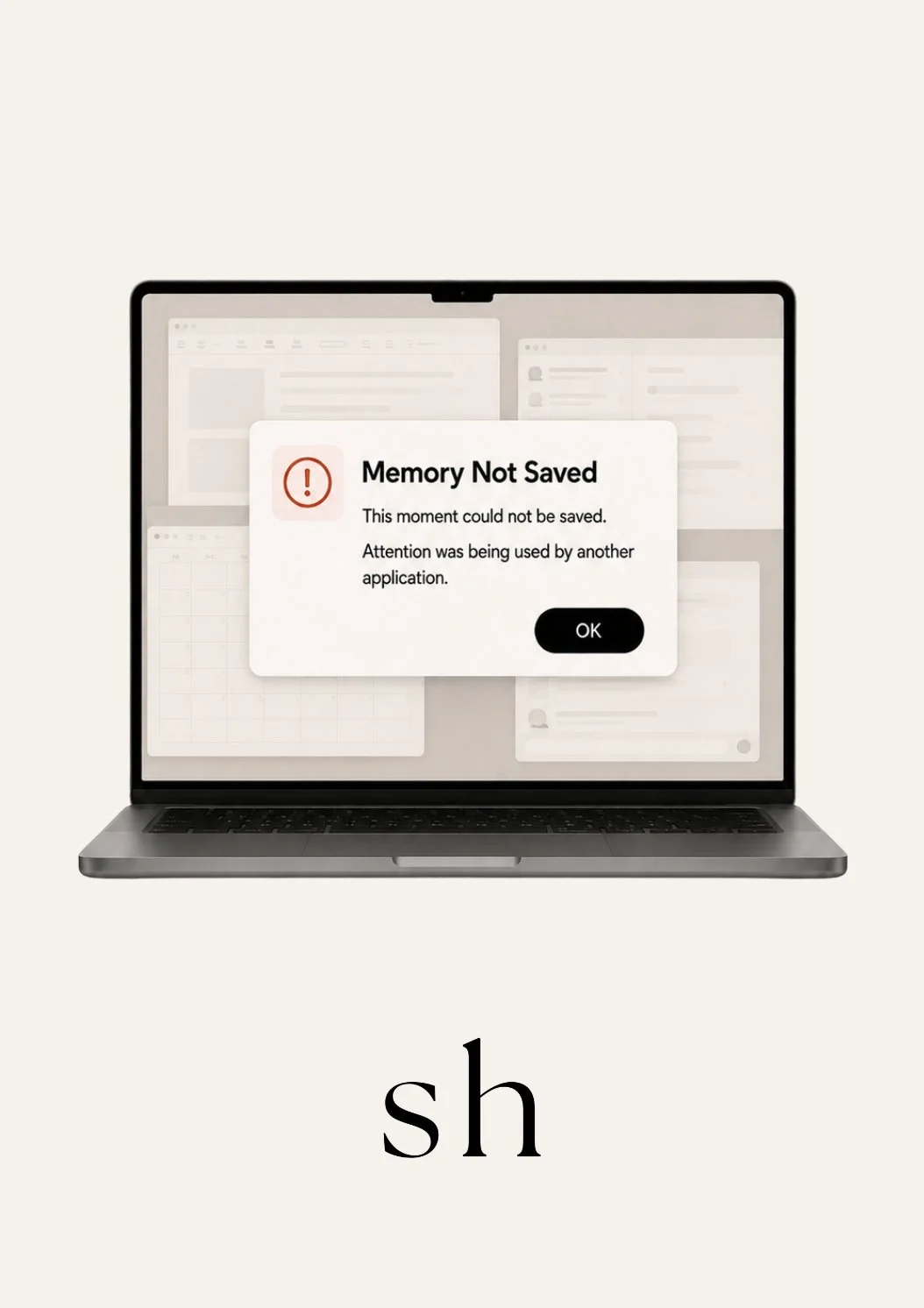
The part of the brain most important for making memories is called the hippocampus. This small, seahorse-shaped structure binds the sights, sounds, emotions and nitty-gritty details of our passing moments into something we later remember.
Divided attention leaves fewer of those details intact.
The brain receives a series of disconnected fragments instead of one rich, continuous experience strong enough to hold onto. This is one reason busy days can feel strangely empty in retrospect, and why entire weeks can go by in a blur.
When our attention is constantly pulled in different directions, more of our lives happen in the background.
The result isn’t just a shorter attention span, but a thinner experience of time itself.
Ten hours spent jumping between tasks can leave almost no footprint, while a single focused moment can be remembered decades later. The same applies over longer stretches of time – we tend to remember the years that were filled with memories that felt distinct, not those that passed by on autopilot.
The moments we experience without interruption are the ones that really stick.
So in a world that’s turned distraction into the default, how can we stop trading depth for speed?
Bring Back Single-Tasking
Not all multitasking is created equal.
There’s a difference between exercising while listening to music and having dinner with someone while also skimming through emails under the table.
Mundane physical tasks don’t compete for the same slice of attention as mentally demanding ones, which is why walking and talking, or folding laundry with an audiobook in the background, make perfectly good companions.
Having said that, since when did it become so weird to do one thing at a time?
Days lived in fragments come at the expense of remembering them. Our brains aren’t built for multitasking, so maybe our days weren’t meant to be either.
-
Why is it so hard to do my work? The challenge of attention residue when switching between work tasks. Leroy, S. (2009). Organizational Behavior and Human Decision Processes, 109(2), 168–181.
Executive control of cognitive processes in task switching. Rubinstein, J. S., Meyer, D. E., & Evans, J. E. (2001). Journal of Experimental Psychology: Human Perception and Performance, 27(4), 763–797.
Modulation of competing memory systems by distraction. Foerde, K., Knowlton, B. J., & Poldrack, R. A. (2006). Proceedings of the National Academy of Sciences, 103(31), 11778–11783.
Enjoy this article?
Absolutely no spam. Ever.

About The Author
Shaady Harrison is a British medical doctor, writer and private advisor specialising in the intersection of psychology, calm and performance.