
The Smartest Person in the Room Just Got Fired
DR SHAADY HARRISON | 3 minutes
They’re watching their every move.
Behind a closed door somewhere deep in Texas, a group of people with more degrees and technical credentials than a small university are fighting it out for one of the most extraordinary jobs on Earth.
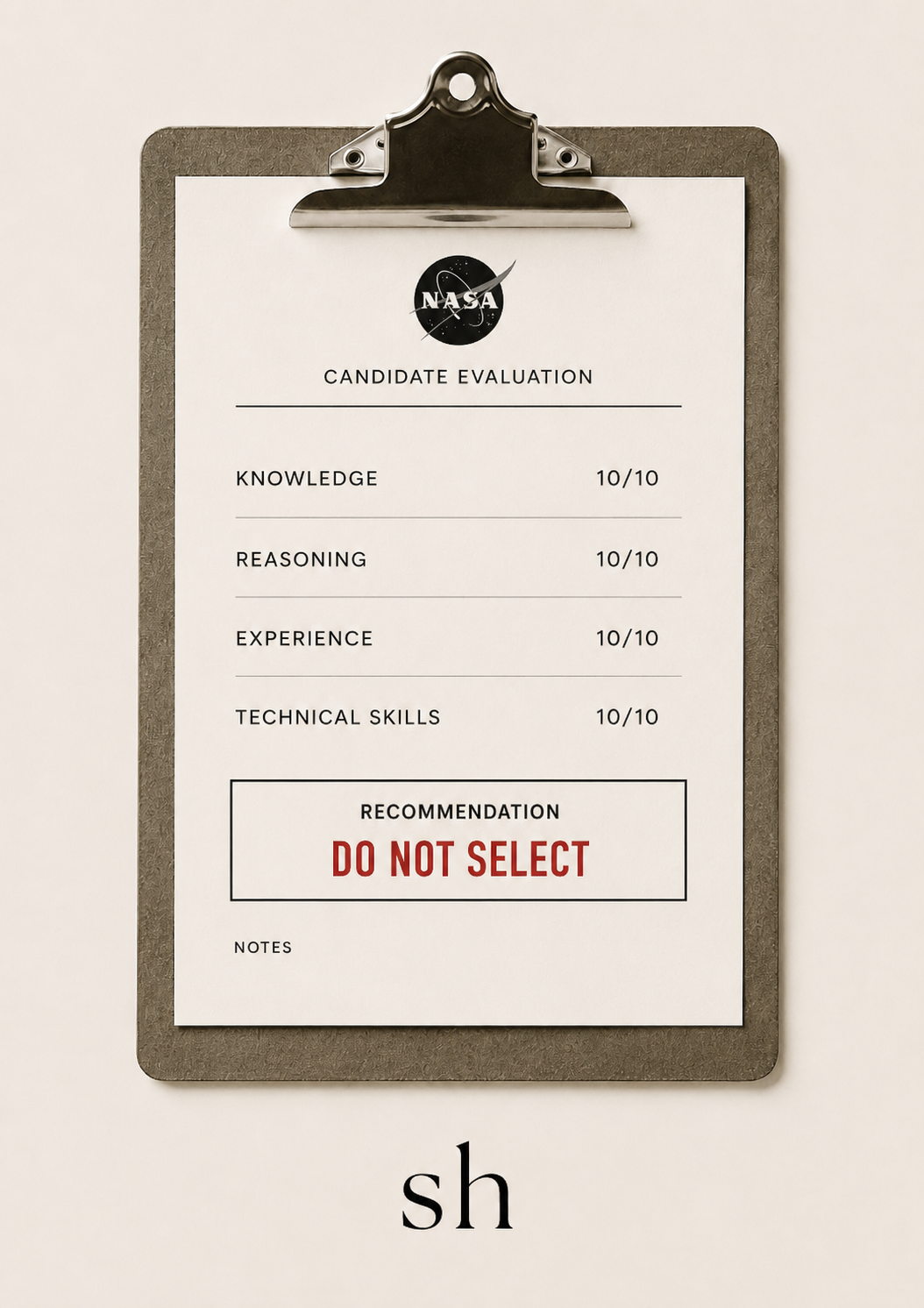
But NASA isn’t testing for the cleverest person in the room.
They’re testing for behaviour.
Who speaks first, who listens, who stays calm, who builds trust, who breaks it.
In its endless pursuit for excellence, space travel figured something out long before the rest of us.
When brilliance becomes the baseline, the most valuable skills are no longer technical.
They’re human.
A New Playing Field
Knowing more than the person next to you has always been an advantage.
For generations we've built schools, businesses and entire careers around the idea that knowledge is power. Expertise wasn't a given; it was earned through years of study, experience and learning the hard way.
That is, until artificial intelligence came along.
We’re now living in a world where complex legal contracts can be analysed in minutes, software platforms can be built from a single prompt, and months of deep work can be done in an afternoon.
But this incredible leap in capability leaves us with an unexpected problem.
It’s not that AI knows too much.
It's that suddenly everyone else does too.
Look Up
Every technological breakthrough in history removed one bottleneck and created another.
When one layer of work becomes cheap, the layer above it becomes more valuable.
When tractors came along, leverage moved from muscle to management. When cheap manufacturing arrived, the advantage moved to design, marketing and branding.
Historically, technology hasn’t destroyed human value.
It’s just relocated it.
AI is making expertise available to everyone, but expertise has never been the only thing that gets the job done.
Artificial intelligence can explain conflict, but it can’t repair a relationship. It can prepare a business strategy, but it can’t get hundreds of human beings to move in the same direction. It can generate a whole lot of words, but it can’t make people trust the person saying them.
When everyone in the room has access to extraordinary knowledge, the advantage moves higher into the layers that are harder to replicate.
Things like holding a group together, staying calm under pressure, making people feel safe, and knowing when to listen.
In other words, all of the stuff evolution has been prioritising all along.
Back To Basics
Long before humans learnt to read, they learnt to read each other.
It mattered less who had the biggest brain and more who could co-operate, build trust, create calm and unite people around a common goal.
It’s no coincidence that the oldest human skills are now proving remarkably future-proof.
As technology races forwards, the qualities we've spent millennia developing are becoming the hardest ones to replicate.
In other words, we may spend the next decade mass-producing intelligence, only to discover that wasn’t the most important part anyway.
-
Woolley, A.W. et al. (2010). Evidence for a Collective Intelligence Factor in the Performance of Human Groups. Science, 330(6004), 686–688.
Edmondson, A.C. (1999). Psychological Safety and Learning Behavior in Work Teams. Administrative Science Quarterly, 44(2), 350–383
Pentland, A. (2008). Honest Signals: How They Shape Our World. MIT Press.
Enjoy this article?
Absolutely no spam. Ever.

About The Author
Shaady Harrison is a British medical doctor, writer and private advisor specialising in the intersection of psychology, calm and performance.