
Gratitude is Pointless
DR SHAADY HARRISON | 3 minutes
Not all emotions are created equal.
The human brain spent millions of years perfecting the fear response, then sharpened it, obsessed over it and made it run faster than conscious thought.
It had millions of years to do the same for gratitude.
It didn’t bother.
We’ve Got Blinkers On
Most of us are surrounded by things we once really wanted. Then, almost without noticing, they suddenly became normal.
The human brain is exceptionally good at turning blessings into background noise.
This isn’t a personal failing – it’s a predictable feature of our biology. Our ancestors survived by noticing what was wrong; the humans who spotted problems tended to outlive the ones who missed them.
Over time, we developed a deeply wired tendency to focus on the bad stuff.
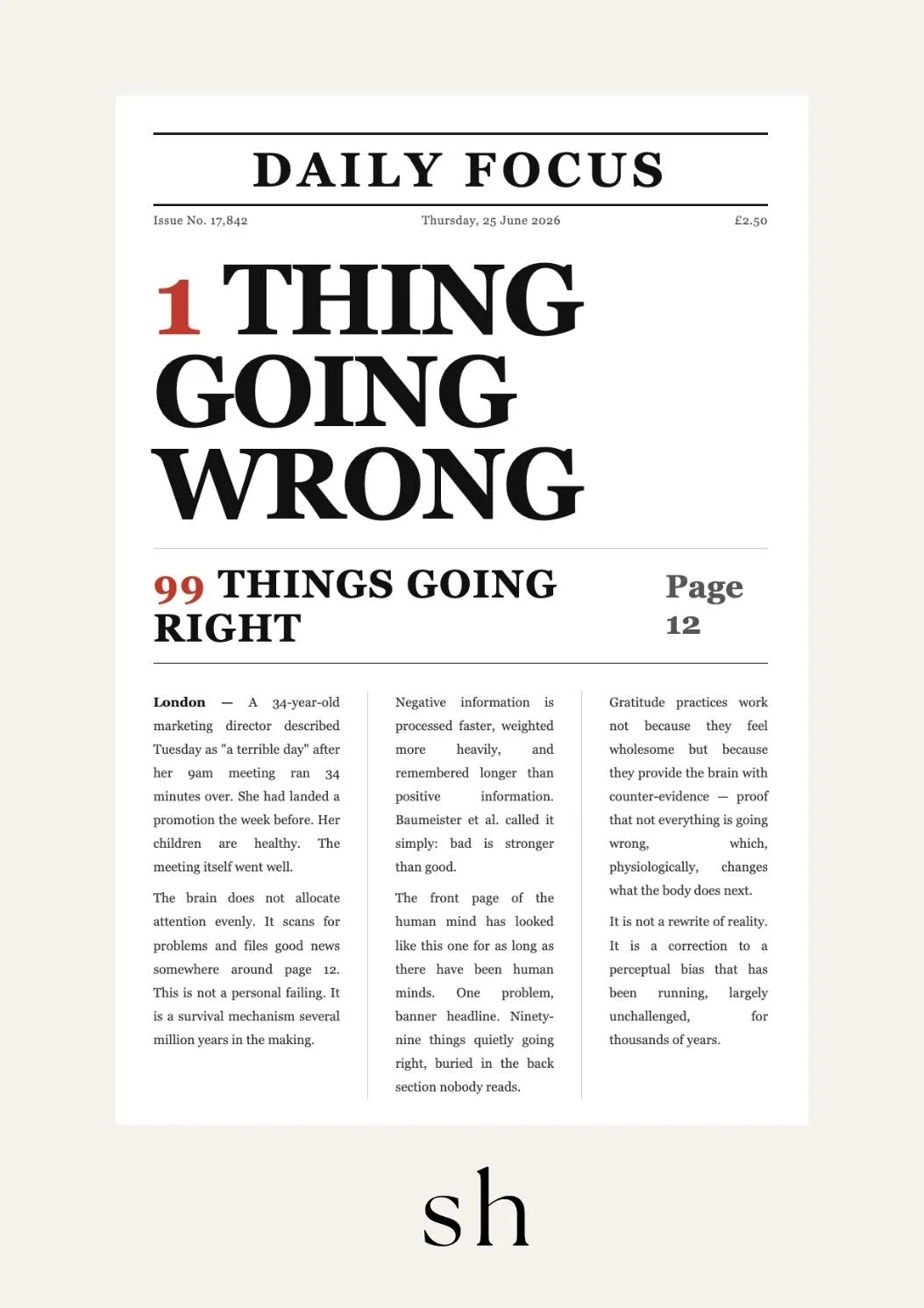
Negative information is processed more quickly, receives more attention and is remembered more vividly than positive information. This explains why we can completely ignore the areas of our lives going right while being consumed by the ones going wrong.
Flip The Script
Focusing on the good stuff doesn’t just feel nice – it changes our physiology.
Gratitude functions as a biological safety signal.
Deliberately paying attention to what’s going right provides the brain with evidence that everything isn’t going wrong. And when we stop scanning for problems, the body behaves differently too.
The body keeps score of what the mind repeatedly searches for.
This explains why gratitude practices are associated with everything from better health to lower cortisol levels.
Grateful people also tend to be more generous, forgiving, and better at maintaining relationships – which funnily enough create even more of the conditions that lead to better wellbeing in the first place.
The Big Picture
Feeling dissatisfied in a life filled with good things is one of the most universal human experiences there is. Very few of us wake up each morning consciously appreciating our warm beds, healthy family, or functioning kidneys.
Focusing on the upside doesn’t come naturally for our brains – which is exactly why we have to work so hard to cultivate it.
What we pay attention to gradually becomes our reality.
Taking time to notice our wins reminds the brain that our problems are only part of the story. Over time, this changes the lens through which we see the world.
Gratitude is biologically pointless – and yet one of the most important skills to cultivate if you want to live a good life.
When we deliberately notice what’s going right, we’re correcting a perceptual bias that’s been running for thousands of years.
That’s not inventing a better reality.
It’s just seeing a little more of the real one.
-
Bad is stronger than good. Baumeister, R. F., Bratslavsky, E., Finkenauer, C., & Vohs, K. D. (2001). Review of general psychology, 5(4), 323-370.
Counting blessings versus burdens: an experimental investigation of gratitude and subjective well-being in daily life. Emmons, R. A., & McCullough, M. E. (2003). Journal of personality and social psychology, 84(2), 377.
The neurobiology of positive emotions and affect: Implications for cultivating happiness and wellbeing
Kok BE, Fredrickson BL, 2010, Oxford Handbook of Positive Psychology.
Enjoy this article?
Absolutely no spam. Ever.

About The Author
Shaady Harrison is a British medical doctor, writer and private advisor specialising in the intersection of psychology, calm and performance.