
How to Move Forwards
DR SHAADY HARRISON | 3 minutes
I’m sitting in a classroom full of 16-year-olds.
It’s my birthday - everyone’s wishing me well.
“Happy birthday!”
“The big seventeen!”
It’s all lovely.
Except for the fact I’ve just turned twenty-two.
How did I end up in a musty classroom filled with kids six years younger than me? Let’s rewind a bit.
Becoming a doctor was never part of the plan when I was growing up. In fact, medicine didn’t even cross my mind until I was twenty-one and about to finish a degree in psychology.
By the time I got my act together, the path ahead didn’t look too appealing. While my friends would be starting shiny graduate schemes and high-powered jobs, I would be pulling into a car park full of teenagers being dropped off by their parents.
In other words, while my peers would be propelling forwards, I would be well and truly going backwards.
Why Our Brains Hate Backwards
There are moments in life when the next step forward doesn’t visibly resemble progress at all. From the outside, it can look like failure; a resignation letter instead of a promotion, a pay cut instead of a raise, a relationship ending when everyone else is settling down.
We’re trained to read these moments as losses.
The human brain is exceptionally sensitive to loss. For most of human history, losing something – food, status, protection, belonging – was rarely neutral. It often meant danger. So when something familiar is removed, the nervous system has learned to react first and ask questions later.
Fast forward to today and we have a deeply ingrained template for progress. It looks clean and satisfying – like milestones, pay rises and LinkedIn announcements, all wrapped up neatly with a bow.
It almost never looks like going backwards.
Our nervous systems have evolved to prioritise safety over growth. Left to their own devices, they’ll always vote for what feels good now, rather than what might be better later. A draining role with a steady pay cheque will always win over a leap into ambiguity.
Stepping off a conventional path introduces social friction and uncertainty – both of which our prehistoric minds interpret as risk.
As far as our brains are concerned, misery we know will almost always beat uncertainty we don’t.
Seeing the Big Picture
Modern life has trained us to think in straight lines.
Careers move upwards, salaries rise, relationships become increasingly polished. In reality, the lives that appear impressive from a distance are rarely that neat and tidy when you zoom in.
Periods of real change tend to look messy from the outside.
They require us to tolerate the gut-wrenching discomfort of stepping off a path beautifully laid out in front of us, in favour of one that’s uncomfortable and uncertain.
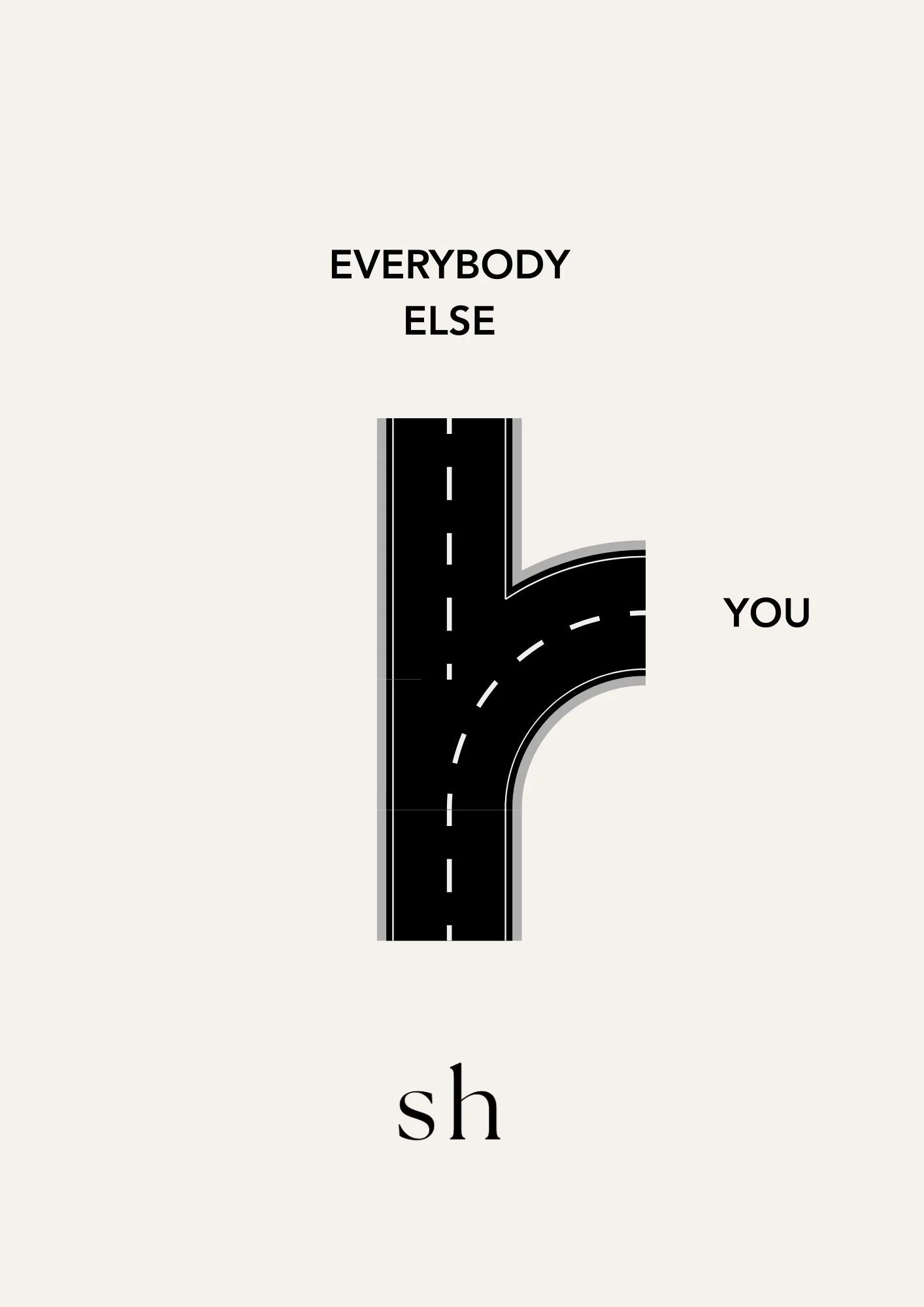
Big, meaningful change almost always involves some combination of temporary loss.
Our brains find this deeply unsettling.
Starting a business often means earning less before earning more. Leaving a role can mean losing status before gaining clarity. Ending a relationship can mean grief long before relief becomes visible. We’re wired to seek fast feedback – small, comforting signs that we’ve made the right call.
Big life changes rarely provide this.
When judged in the moment, many of the choices that level up our lives look suspiciously like backwards steps.
They seem badly-timed, impractical and messy.
Until one day we look back, and they don’t.
-
Loss Aversion in the Brain: A Meta-Analysis of Neuroimaging Studies.
Bartra, O., McGuire, J. T., & Kable, J. W., 2016, Neuroscience & Biobehavioral Reviews, 68, 902–913.Intolerance of Uncertainty and Anxiety: A Meta-Analysis and Theoretical Review.
Carleton, R. N., 2016, Journal of Anxiety Disorders, 41, 30–43.Temporal Discounting and the Brain: Implications for Choice and Self-Control.
Peters, J., & Büchel, C., 2017, Trends in Cognitive Sciences, 21(9), 622–635.
Enjoy this article?
Absolutely no spam. Ever.

About The Author
Shaady Harrison is a British medical doctor, writer and private advisor specialising in the intersection of psychology, calm and performance.