
The Power of Consistent Sleep
DR SHAADY HARRISON | 3 minutes
With hindsight, it was a pretty weird plan.
In 1938, two sleep researchers named Nathaniel Kleitman and Bruce Richardson travelled to Kentucky with nothing but notebooks and a few basic supplies.
Their destination was Mammoth Cave – a huge underground system without a trace of natural light. On arrival, they unpacked their gear and set up a small research camp.
They wouldn’t see sunlight again for thirty-two days.
Their goal was simple: to understand what happens when the human body no longer receives clear signals that it’s day or night.
In just a few short days, their biology began to unravel. Without a consistent cue from the sun that it was morning, their internal clocks went haywire. Sleep became fragmented, alertness fluctuated unpredictably, and their core body temperatures drifted.
It was one of the first demonstrations of something we now know with certainty.
Our bodies need strong, consistent timing signals to function at their best.
Fast forward to today and the world of sleep has become a minefield. Tracking rings, melatonin, chronotypes, supplements – what if the key to better sleep is as simple as waking up at the same time every morning?
Understanding the science behind consistent sleep changed how I approach my schedule three hundred and sixty-five days a year.
I hope it’ll do the same for you.
The Power of a Consistent Wake Time
Your circadian rhythm is a roughly 24-hour internal clock that plays a huge role in your biology. Far from just controlling your sleep cycle, it regulates everything from your stress hormones to your mood and appetite.
Your biological clock craves regularity.
Waking up at the same time every morning anchors your body clock into a healthy and predictable rhythm. From here, your body then regulates the production of hormones. Melatonin is released at the same time every evening making you sleepy before bed. Cortisol spikes at the same time every morning increasing your alertness and waking you up. Deep sleep happens at the same time in the middle of the night. Things start to run like, well, clockwork.
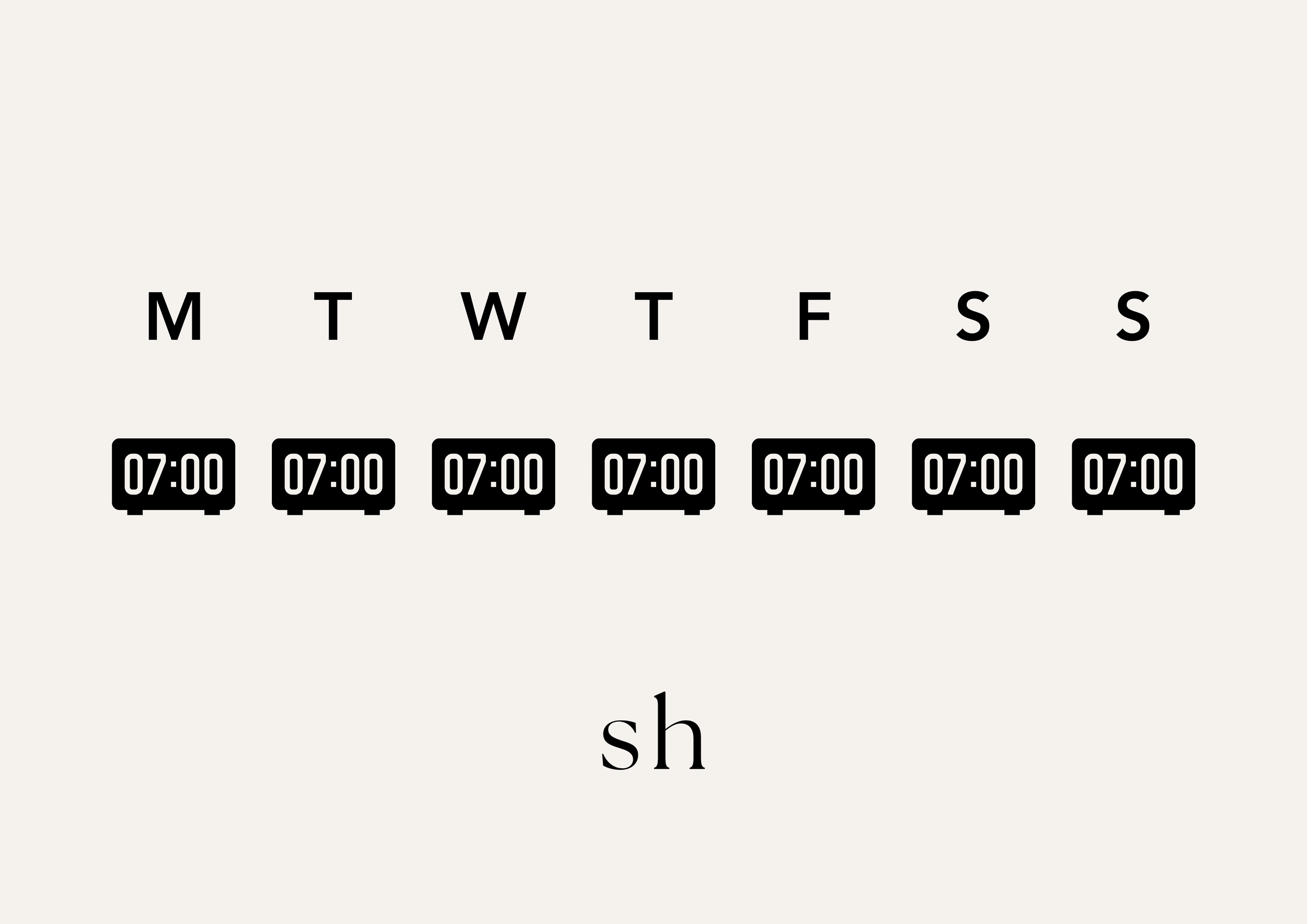
The downstream benefits of this simple change are quite frankly staggering – ranging from a healthier gut microbiome to a lower risk of dementia and depression. In fact, a study with over 60,000 participants found that sleep regularity predicted lifespan more strongly than sleep duration.
In other words, when you sleep matters even more than how long you sleep.
And we don’t need any fancy scientific research when it comes to the most obvious benefit of excellent sleep. High quality sleep leads to a better mood, and a happier mood unlocks better outcomes. In other words, life just goes better when you’re not sluggish and sleep-deprived.
The Bottom Line
For most of us, waking up at the same time every morning doesn’t exactly sound appealing. In the context of our busy and often chronically sleep-deprived lives, it’s a big ask.
The issue is rarely the wake time itself - it’s what happens the night before. We go to bed too late, slowly running up a sleep debt as the week goes on, and then try and repair the damage with weekend lie-ins.
The solution isn’t to eliminate late nights altogether, but to separate the ones that add real value from the pointless ones.
Nobody ever regrets skipping another late night on the sofa watching Netflix.
Whether we like it or not, our bodies need consistency to function at their best. If your work or kids don’t make it impossible, pick your wake time and stick to it.
It might just be one of the best investments you make.
-
Sleep regularity is a stronger predictor of mortality risk than sleep duration: a prospective cohort study. Windred, D. P., Burns, A. C., Lane, J. M., Saxena, R., Rutter, M. K., Cain, S. W., & Phillips, A. J. (2024). Sleep, 47(1), 25.
Circadian misalignment and health. Baron, K. G., & Reid, K. J. (2014). International review of psychiatry, 26(2), 139-154.
Sleep timing, sleep consistency, and health in adults: a systematic review. Chaput, J. P., Dutil, C., Featherstone, R., Ross, R., Giangregorio, L., Saunders, T. J., ... & Carrier, J. (2020). Applied Physiology, Nutrition, and Metabolism, 45(10), S232-S247.
Enjoy this article?
Absolutely no spam. Ever.

About The Author
Shaady Harrison is a British medical doctor, writer and private advisor specialising in the intersection of psychology, calm and performance.