
The Curious Case of The Other You
DR SHAADY HARRISON | 4 minutes
You’ve discovered that you can time travel.
It’s ten years from now.
You’re sitting across a table having dinner with a stranger – they’re telling you everything that’s happened in their life over the last decade.
You’re hanging onto their every word.
The wins.
The losses.
The joys.
The regret.
The surprises.
You’re completely absorbed.
The more they talk, the more fascinated you become. You’ve never been more interested to hear someone’s story. Who is this person?
It’s you.
Your Future Self Is Built Today
How would today’s decisions change if it was your future self calling the shots instead of you?
With never-ending demands on our time and attention, most of us don’t need to look far for evidence that we could make better choices. Unmanaged stress, stretched relationships, missed workouts, late nights.
Humans are masters of self-deception.
We do an excellent job of unconsciously convincing ourselves that these little decisions don’t make a measurable difference to our lives.
Why?
Because it would be too uncomfortable to acknowledge otherwise.
Our lives are shaped by our ability to sacrifice temporary rewards now for more substantial payoffs later.
So how can we get better at playing long term games instead of ungratifyingly short ones?
The answer lies in an fMRI machine.
The Other You
fMRI machines revolutionised our understanding of the human brain.
By tracking changes in blood flow, the technology allows us to measure brain activity in real time. When an area of the brain becomes active during a task, it “lights up” on the scan, effectively mapping out which region is responsible for what.
Let’s imagine we decide to do three mini experiments together.
You’re lying in the scanner.
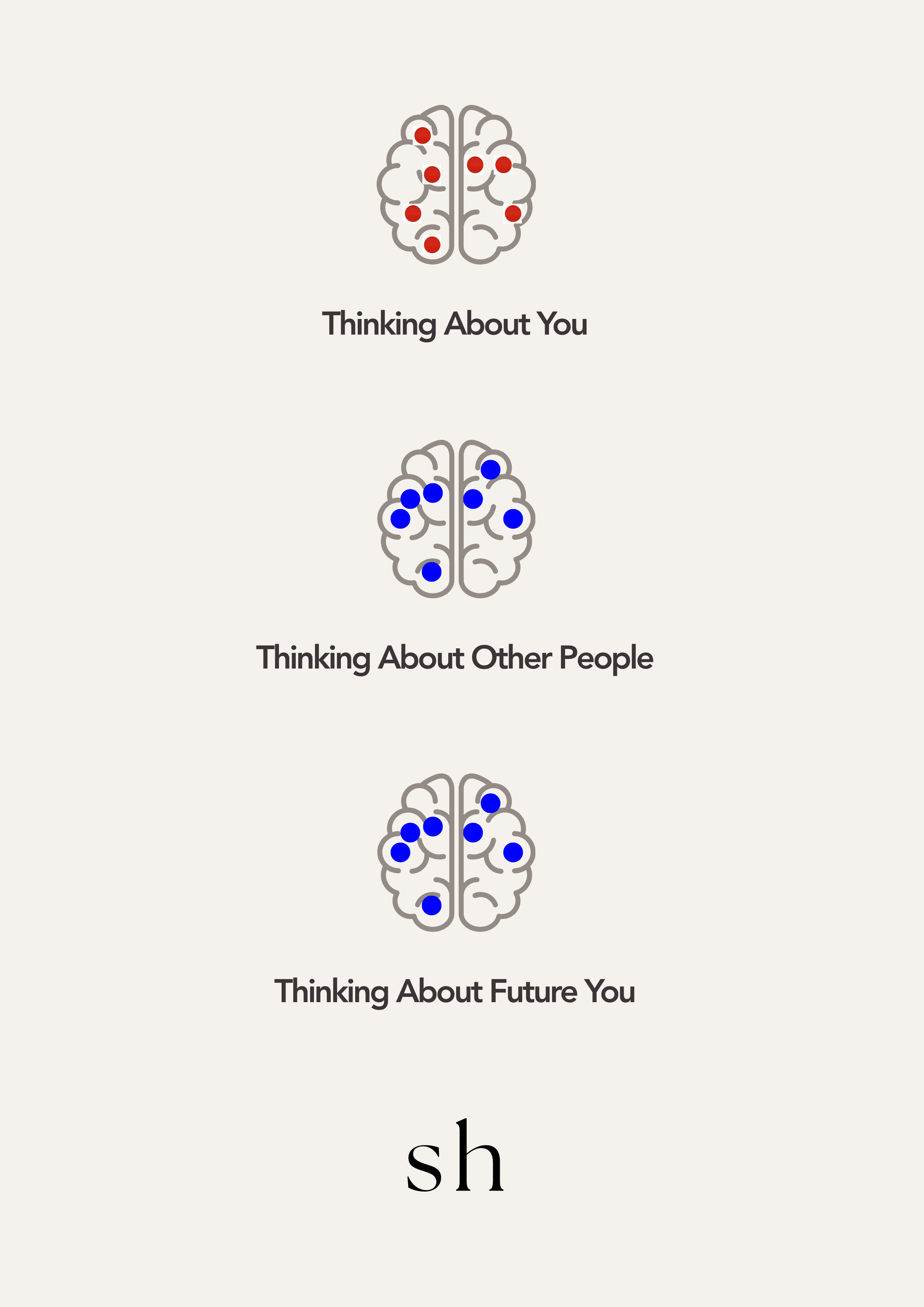
For the first, I ask you to think about yourself. Your brain responds with a pattern of activity – let’s call this ‘Thinking About Yourself’.
Next, I ask you to think about somebody else. Anyone will do – a friend, stranger, colleague, family member. You follow suit. Unsurprisingly, a completely different pattern of activity shows up. Let’s call this ‘Thinking About Others’.
So far, so good. Our minds behave entirely differently when processing information about ourselves compared to other people. This makes sense.
You wait for your final instruction. I ask you to think about yourself, but in twenty years’ time.
This time, your brain does something weird.
I look to the ‘Thinking About Yourself’ network.
Nothing. Not a flash. Instead, something strange has happened.
You’ve activated ‘Thinking about Others’.
This is a major problem.
Somebody Else’s Problem
Hal Hershfield is a Professor at UCLA. After nearly two decades of research, his work has pioneered understanding of our relationship with our future selves.
When we think about our future selves, our brains behave as if we’re thinking about a completely different person.
“We see our future selves as if they are other people” Hershfield explains. But this discovery is more than just a remarkable insight into our psychology. It’s a key that unlocks the door to better long-term decision-making.
Why?
As Hershfield writes, it “matters for a very simple reason: we treat strangers differently.”
The less connected we are to someone, the less likely we are to make sacrifices on their behalf.
This goes far in explaining why we’re masterminds of making small decisions that snowball into big problems for ourselves later down the line.
Our future selves feel blurry and distant from us.
They’re strangers.
We opt for short term gratification because we can’t quite picture the long-term penalties that will eventually come our way.
As far as our brains are concerned, they’re somebody else’s problem.
Looking Out For Your Future Self
Being mindful of both the present and future is key for a happy life - we all need to indulge from time to time. However, the motivation for building healthy habits lies in the future.
Here are a few ways to stop throwing your future self under the bus.
1) Make Things More Tangible
There’s an easy way of getting better at thinking about your future self.
Do it more often.
Matt Sly is a software executive from Boston. In 2002 his mind wandered to a letter he’d written to his future self as a child and FutureMe was born. The premise is simple. Write a letter to your future self and set the time frame that you want it delivered back to you.
The more often we remind ourselves of our future self, the more likely we are to make sacrifices on their behalf.
Today, over twenty million letters have been sent from people to their future selves.
It’s weird, but it works. An ingenious study in the Journal of Experimental Psychology found that people who wrote letters to themselves twenty years in the future exercised more in the days afterwards.
2) Imagine Yourself One Hour From Now
We don’t necessarily go to the gym because of how it feels when we’re there. We go because of how great it feels afterwards.
Imagining yourself one hour from now blurs the boundary between your present and future self.
Making a positive choice becomes easier when you focus your attention on how you’ll feel in just sixty minutes time.
3) Be Helpful
A little compassion goes a long way.
Tomorrow’s you isn’t going to want to wake up early and exercise any more than today’s does.
Remove as many small barriers as you can in advance. If you want to work out in the morning, put your gym clothes and shoes out now. Whether it’s priming the coffee machine or getting breakfast prepped beforehand, give your future self a helping hand.
The Big Picture
Our lives are shaped by our ability to trade small comforts now for more valuable payoffs later.
Get to know your future self.
They’re not quite as far away as you think.
-
Saving for the future self: Neural measures of future self-continuity predict temporal discounting.
Ersner-Hershfield, H., Wimmer, G. E., & Knutson, B. (2009). Social Cognitive and Affective Neuroscience, 4(1), 85–92.Your Future Self: How to Make Tomorrow Better Today.
Hershfield, H. (2023). Little, Brown Spark.Temporal differences in trait self-ascription: When the self is seen as an other.
Pronin, E., & Ross, L. (2006). Journal of Personality and Social Psychology, 90(2), 197–209.Future self-continuity is associated with improved health and increased exercise behavior.
Rutchick, A. M., Slepian, M. L., Reyes, M. O., Pleskus, L. N., & Hershfield, H. E. (2018). Journal of Experimental Psychology: Applied, 24(1), 72–85.
Enjoy this article?
Absolutely no spam. Ever.

About The Author
Shaady Harrison is a British medical doctor, writer and private advisor specialising in the intersection of psychology, calm and performance.