
There’s No Such Thing as a Free Lunch
DR SHAADY HARRISON | 3 minutes
In 2001, Starbucks sneakily introduced something new at the checkout.
It was called the Starbucks card - a small stored-value card that let customers load money once and pay with it later. It seemed harmless at first – a clever way to move people through queues more quickly. But within months, analysts inside the company noticed something interesting. Customers weren’t just paying faster.
They were spending more.
People who normally paused before ordering a second drink stopped pausing. People who once skipped add-ons – extra shots, syrups, pastries – started buying them without thinking. The average transaction value kept climbing.
Why?
When customers loaded cash onto the card, the pain of parting with money happened upfront. Every purchase after that felt strangely lighter – almost free. The physical ritual of handing over money had disappeared. And once the exchange became invisible, so did the cost.
Behavioural economists later used Starbucks as a landmark example of a universal truth:
When a loss stops feeling like a loss, we stop noticing how much we’re losing.
Which brings us to our attention.
Your Most Valuable Resource
We like to believe our lives are shaped by the big decisions we make. In reality, they’re defined by the constant allocation of four basic resources: time, money, energy and attention.
We protect the first three instinctively because they create obvious signals when we lose them. Time runs out, money leaves an account, energy drains.
We’re aware they’re finite, so we act accordingly.
Attention doesn’t come with the same warnings. It isn’t visible, countable or stored anywhere. It’s intangible, and therefore easy to treat as infinite.
We’re now living in an age of unlimited noise.
In a world where tech plays an increasingly invasive role in our days, small digital interruptions pull us towards low-value signals on an almost hourly basis. Slowly, this erodes our capacity for deep work and leaves fewer intact stretches of focus for the parts of life that really matter.
Our careers, health and relationships are all downstream of our ability to pay attention.
Modern technology has trained our brains to expect constant stimulation. With the swipe of a button, there’s an endless stream of ever-changing information just waiting to be read and interacted with.
The biggest problem?
It’s free.
The Invisible Transaction
When money doesn’t leave our hands, we lose the instant feedback loop telling our brains that something has been lost. For this reason, we find it difficult to recognise our time on our phones as an exchange.
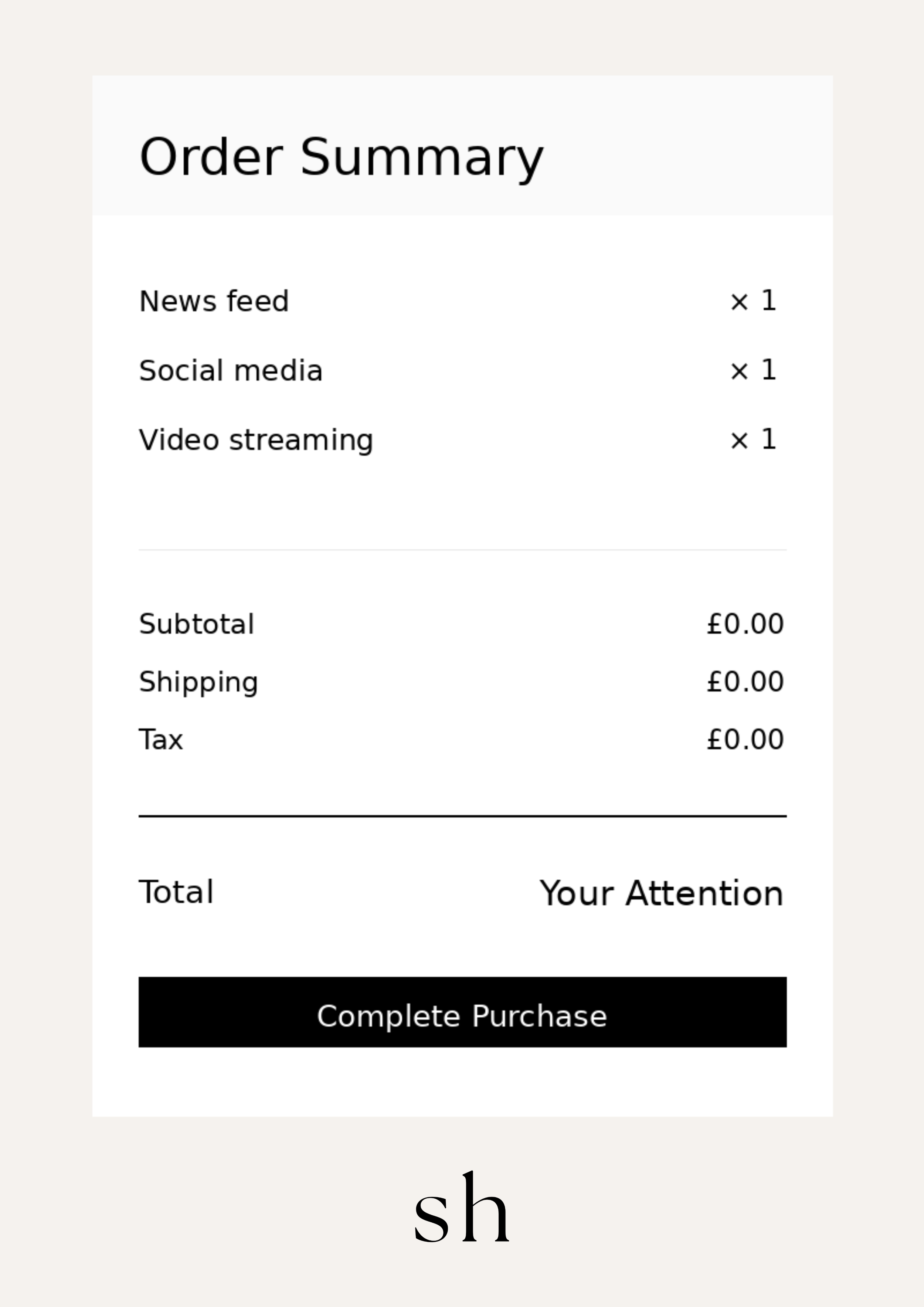
Tech platforms have become skilled at removing the sensation of loss. Autoplay, infinite scroll, pull-to-refresh, notifications – each is carefully designed to bypass the cognitive alarms that normally protect our scarce resources.
When our brains don’t register a transaction, our behaviour changes.
Unlike spent money, which eventually appears on a bank statement, there’s no tangible trace of our time spent scrolling our phones. We don’t receive a monthly bill. No number turns red. No balance drops. Nothing signals that something valuable has been lost.
But it has.
An invisible loss is still a loss.
Every scroll, tap and swipe costs time, energy and focus. While our bank balances remain safely untouched, the bill arrives later in the form of reduced bandwidth, low-level anxiety, and the rising sense of being permanently on the back foot.
We pay with our attention; we just never see the receipt afterwards.
Reclaim Your Attention
In a world overflowing with noise, a quiet mind has emerged as a rare and unexpected form of leverage.
Our best ideas, deepest relationships and most meaningful work all live on the other side of focused, uninterrupted time. Reclaiming our attention doesn’t require a full digital detox, but small changes matter. It’s difficult to access the best of our minds when empty moments are habitually filled with the constant buzz of information.
The modern world’s been designed to make our attention feel free.
It isn’t.
The better we get at noticing the exchange, the easier it becomes to choose what’s worth paying for.
-
The Cost of Interrupted Work: More Speed and Stress. Mark, G., Gudith, D., & Klocke, U. (2008). Proceedings of the SIGCHI Conference on Human Factors in Computing Systems.
Smartphones and cognition: A review of research exploring the links between mobile technology habits and cognitive functioning. Wilmer, H. H., Sherman, L. E., & Chein, J. M. (2017). Frontiers in Psychology, 8, 605.
The distracted mind: Ancient brains in a high-tech world. Gazzaley, A., & Rosen, L. (2016). MIT Press.
Enjoy this article?
Absolutely no spam. Ever.

About The Author
Shaady Harrison is a British medical doctor, writer and private advisor specialising in the intersection of psychology, calm and performance.