
Why Can’t We Stop Scrolling?
DR SHAADY HARRISON | 3 minutes
It’s 2005.
Three Microsoft engineers are sitting around a table eating pizza. They’re trying to figure out why image search results feel so clunky, and how to stop users dropping off when they get to the bottom of the page.
Then it hits them.
What if the page never ends?
Instead of forcing users to stop and consciously decide whether to continue, more images would automatically load as the user moves down the screen.
It’s genius – instead of having to click to the next page, the boundary between one page just dissolves right into the next.
Within a few years, it’s been adopted by every major social platform.
They’ve definitely solved the clunkiness.
Unfortunately, they’ve also just accidentally invented doomscrolling.
The Psychology of Stopping
The human brain is used to finish lines.
We live in a world with natural stopping points – day becomes night, winter turns to spring, storms eventually pass.
Up until pretty recently, this also reflected how we consumed media. Everything had clear edges – newspapers ran out of pages, book chapters finished, television episodes ended at a certain time.
These natural transitions created psychological checkpoints where our brains could pause and decide whether we actually want to continue.
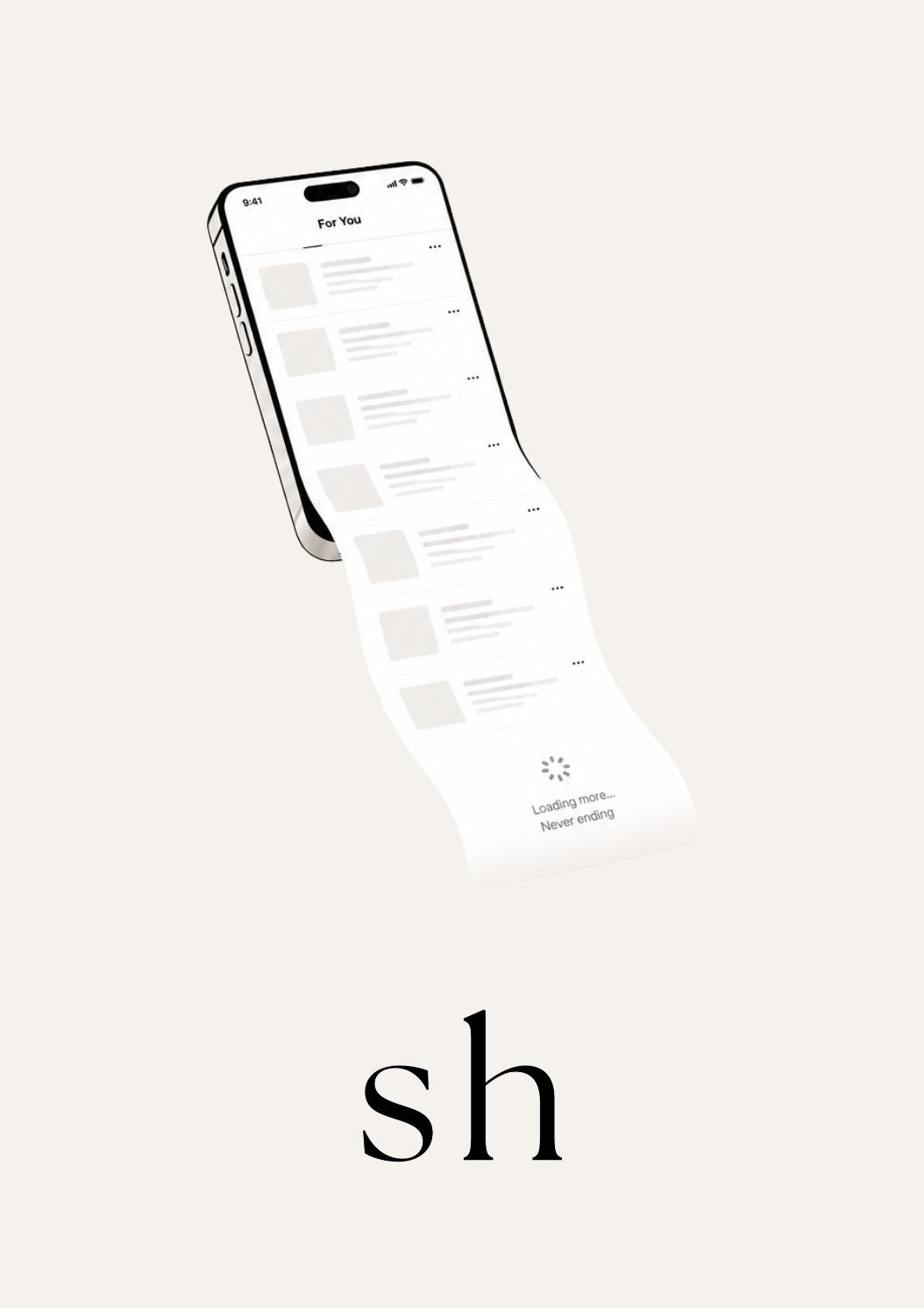
Infinite scroll didn’t just move the checkpoint - it deleted it altogether.
Why We Don’t Stop
Our brains rely heavily on environmental signals to regulate behaviour.
These are called friction points – small interruptions that force conscious decision-making back online. In other words, they give the brain a chance to ask an important question.
Do I want to keep doing this?
Infinite scroll throws the finish line out the window – the next video loads before the last has ended, the next story appears before you’ve looked up, the next post arrives before your brain has finished processing the last.
The experience becomes continuous, automatic, and weirdly hypnotic.
This hasn’t happened by accident.
The less interruption there is between one action and the next, the less likely we are to stop.
This explains why Netflix autoplays the next episode and why casinos don’t have clocks or windows.
Infinite scroll traps the brain in a loop of continuous and repetitive behaviour. The nervous system never receives a signal that it’s time to stop.
So it doesn’t.
Add Friction Again
We get a limited number of hours on this planet – most of us don’t want to spend them scrolling.
Like slot machines, phone apps are carefully designed to keep your hands moving. Scrolling is a motor loop, so anything that disrupts the movement pulls the brain out of autopilot.
Tiny interruptions break automatic behaviour.
Small resets like moving to another room, standing up, or getting up to make a drink pull the nervous system back into the real world.
But the most powerful changes happen before the first swipe, not after it. Anything that makes the app slightly harder to open dramatically shifts the odds in your favour.
Human behaviour changes surprisingly quickly when we deliberately reintroduce friction.
This might look like deleting apps from your home screen, logging out after each use, or even keeping social media off your phone entirely.
Our brains aren’t designed to consume endless feeds of information.
Modern tech removed the stop signs.
That doesn’t mean we have to keep driving.
-
The loop and reasons to break it: Investigating infinite scrolling behaviour in social media applications and reasons to stop. Rixen, J. O., Meinhardt, L. M., Glöckler, et al. (2023). Proceedings of the ACM on Human-Computer Interaction, 7(MHCI), 1-22.
Irresistible: The Rise of Addictive Technology and the Business of Keeping Us Hooked. Alter, A. 2017. Penguin Press.
The Power of Habit: Why we do what we do and how to change. Duhigg, C., 2013. Random House.
Enjoy this article?
Absolutely no spam. Ever.

About The Author
Shaady Harrison is a British medical doctor, writer and private advisor specialising in the intersection of psychology, calm and performance.