
How to Avoid the Eisenhower Problem
DR SHAADY HARRISON | 4 minutes
It was called the twilight shift.
Just seven hours long – from 4-11pm – on paper it looked like a dream. In reality, it was the shift you absolutely dreaded as a newly qualified doctor.
Eight wards.
Over two hundred patients.
One doctor.
The odds weren’t exactly in your favour.
As the twilight doctor, the aim of the game was simple. Keep everyone alive until your backup arrived in the form of the night team at 9pm.
Some twilight shifts were manageable. Others were a constant flow of emergencies you could barely keep up with. A bleeding patient on one side of the hospital immediately followed by a heart attack on the other – your job was to identify the sickest patient on your list and work backwards from there.
One twilight shift, I got a call at 7pm to let me know that a patient had passed away upstairs. It was an expected death, and the family were with her. She was added to my list – I needed to go and make the formal declaration. This is an important job – a patient’s time of death is recorded at the point a doctor confirms it, not at the moment they actually pass away.
I didn’t make it upstairs for over three hours.
The next few hours were a relentless blur of cardiac arrests, deteriorating patients and urgent reviews. It was 10pm by the time I finally reached her. I walked into her room with a pit in my stomach. I had left her family waiting in that room for over three hours.
I had been so wrapped up in firefighting the urgent tasks that I had failed to get to one of the most important.
Which brings us to the Eisenhower Problem.
Why Urgent Always Wins
There are an infinite number of tasks competing for our time and attention at any one time.
Our pre-historic brains have a built-in bias towards immediacy. Anything time-pressured activates the limbic system – the brain’s threat-detection and survival circuitry. Urgent used to mean potential danger; now it means an unanswered email. Unfortunately for us, our nervous system can’t differentiate one from the other.
Urgent tasks trigger a small hit of stress followed by a hit of relief when you resolve them.
It’s why clearing your inbox feels so much more compelling than a quick trip to the gym. Responding to urgent tasks gives us an immediate micro-reward. Important tasks give us a delayed one. Left unchecked, we spend our lives reacting to whatever is shouting the loudest.
This is a problem.
At any one time, our brains are buzzing with thirty low-grade fires. We’re drawn to urgent tasks that give us quick closure because they feel productive and satisfying. Important tasks on the other hand – the ones that change the trajectory of our health, relationships, and lives – rarely offer that instant hit. They are slow, repetitive, and often a bit uncomfortable.
Our lives are defined by our ability to prioritise important tasks over urgent ones.
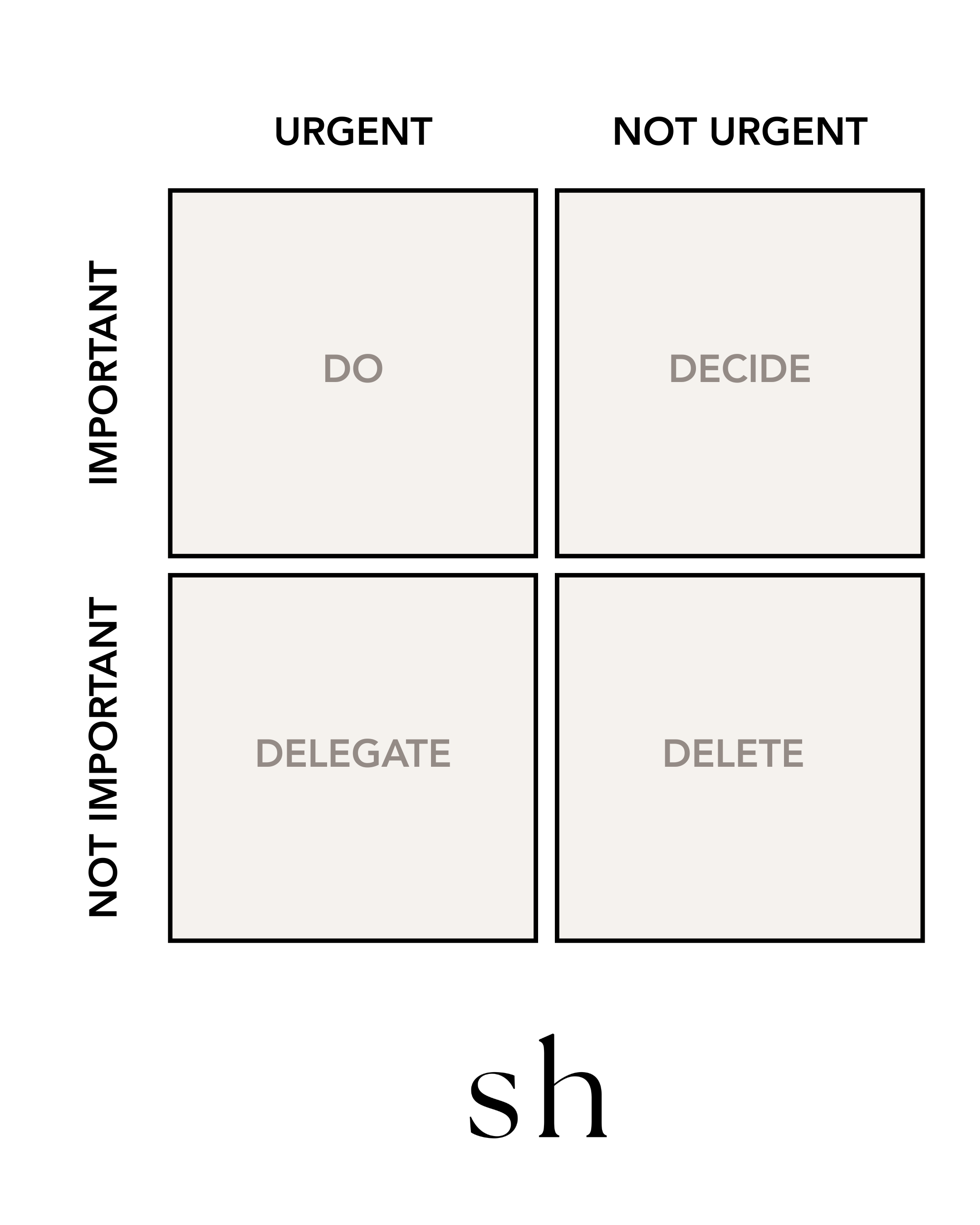
Dwight Eisenhower was the 34th President of the United States. Previously a five-star general, he was famous for his clarity under pressure. His leadership was built on his ruthless preoccupation with separating the urgent from the important. This principle led to the Eisenhower Matrix, a strategic tool for setting priorities.
The tasks that will decide your future rarely feel urgent today.
They only become urgent when something has gone wrong – this is a fatal flaw in our psychology. Nurturing your marriage, investing in friendships, having therapy, taking care of your body, these are the things which will matter most two decades from now. They are also almost always the least urgent.
How to Make Time for the Important Stuff
1) Create Friction Around the Urgent
Turn off notifications. Put your phone in another room. Batch messages at set times. Use airplane mode. Make it harder to be pulled into firefighting mode by reducing the constant drip of urgent cues.
2) If it Matters, Schedule it
Put the important stuff in your calendar like you would a meeting or hospital appointment. Strength training, time with your kids, date nights, friendships – these are the things that change your trajectory ten years from now. Make it as hard as possible to bail on them.
3) Normalise Disappointing People
You can’t prioritise what matters most without declining what doesn’t. Boundaries feel uncomfortable at first because your brain is wired for social approval. Stick with it.
4) Strengthen Your Baseline
A tired, overstimulated brain mislabels everything as urgent. Be more ruthless about self-care, and I don’t mean candles or bubble baths. Put some real time into being calmer – sleep, exercise and tech boundaries stabilise your nervous system and restore your ability to think clearly.
The Bottom Line
Health, relationships and a clear mind are the foundations of a good life. Our pre-historic brains are not wired to prioritise them.
Do what you can to make sure they don’t fall through the cracks.
-
Time Discounting and Time Preference: A Critical Review. Frederick, S., Loewenstein, G., & O’Donoghue, T. (2002). Journal of Economic Literature, 40(2), 351–401.
Emotion circuits in the brain. LeDoux, J. E. (2000). Annual Review of Neuroscience, 23, 155–184.
The brain’s prioritization of immediate rewards: A meta-analysis of temporal discounting. Soutschek, A., & Tobler, P. N. (2020). Cortex, 127, 38–56.
Enjoy this article?
Absolutely no spam. Ever.

About The Author
Shaady Harrison is a British medical doctor, writer and private advisor specialising in the intersection of psychology, calm and performance.