
Why Some Teams Win
DR SHAADY HARRISON | 3 minutes
They called it Project Aristotle.
In 2012, Google decided to spend two years figuring out what separated its greatest teams from its average ones.
They got to work analysing one hundred and eighty employee groups, studying everything from technical skill and IQ to team friendships and how often people socialised outside work.
Somewhere inside all that noise, the data revealed a clear and unexpected winner.
The best teams weren’t smarter.
They were less scared.
The strongest predictor of collective brilliance was whether people felt safe enough to say what they really thought, ask what they didn’t know, and admit when they were wrong.
In other words, one of Silicon Valley’s most trailblazing companies went looking for a technical answer and came back with a nervous system one.
Safety Beats Smart
Whether it’s a boardroom, emergency department or kitchen table, every team runs on two layers of intelligence: what its members collectively think and what they’re willing to say out loud.
The elephant-sized gap between the two is decided by psychological safety.
In losing teams, information is unconsciously edited before it reaches the rest of the group. Mistakes are hidden, questions are swallowed and doubts are softened in an attempt to survive the invisible rules of the room.
But avoiding these tiny moments of discomfort has a nasty habit of turning into bigger problems later.
Silence, it turns out, comes with a pretty hefty price tag.
The Invisible Edit
Social rejection isn’t the same as physical danger - there’s a massive gap between a passive-aggressive email and a predator creeping out of the bushes.
Rather inconveniently, our ancient brains aren’t great at telling the difference though.
Social exclusion lights up the dorsal anterior cingulate cortex – one of the key regions also involved in processing physical pain. The moment the brain detects danger, it pulls the cognitive equivalent of a fire alarm and everything else takes a backseat while it reallocates attention to self-protection.
These invisible calculations run underneath conscious awareness, eating into the precious mental bandwidth required for our best thinking.
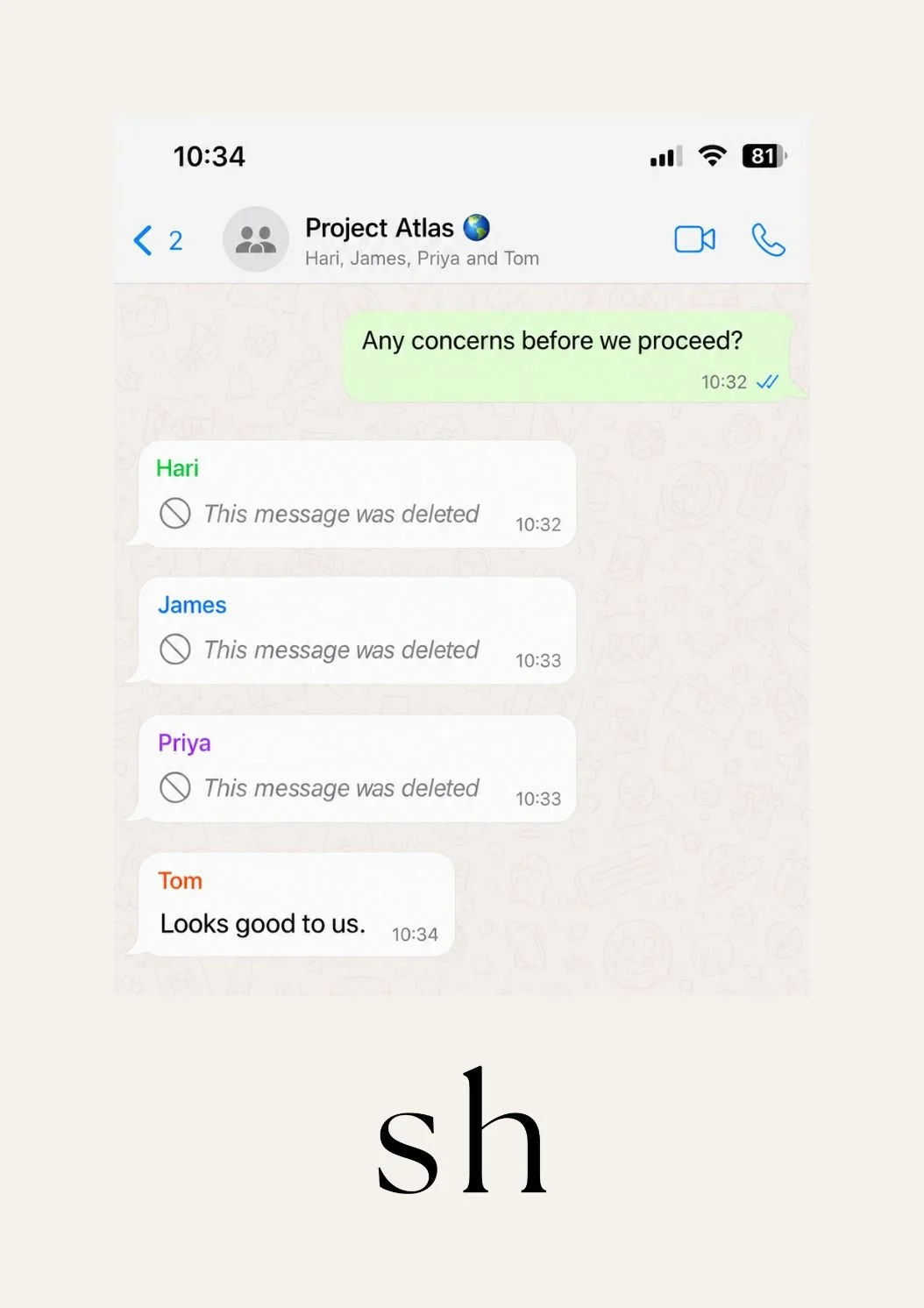
If small moments of vulnerability have previously been punished – even just with a dismissive glance, interruption or slightly awkward silence – the brain quickly learns that speaking up is risky.
And in a room where being wrong feels even slightly dangerous, the safest move is to just keep your mouth shut.
It Starts Upstairs
Feeling safe is a two-player game: the environment sends the signals, but the brain decides how to interpret them.
With all the will in the world, even the safest room on the planet won’t convince a nervous system on high alert that there’s nothing to worry about.
But when it comes to creating a healthy culture, not all voices are created equal.
Psychological safety lives and dies at the top.
Every micro-reaction from a leader teaches people what happens when they speak up.
This doesn’t look like an endless parade of sunshine and rainbows while everyone takes turns telling each other how great they are.
In fact, the healthiest teams often look messier from the outside because they challenge ideas, drag mistakes into the daylight, and say the uncomfortable thing while it’s still cheap to fix.
But the key difference is how people feel afterwards.
A room full of brilliant people holding their tongues performs like a room full of average ones.
But lower the cost of being wrong, and brilliance can finally get to work.
-
Psychological safety and learning behavior in work teams. Edmondson, A. C. (1999). Administrative Science Quarterly, 44(2), 350–383.
Does rejection hurt? An fMRI study of social exclusion. Eisenberger, N. I., Lieberman, M. D., & Williams, K. D. (2003). Science, 302(5643), 290–292.
Effects of social exclusion on cognitive processes: Anticipated aloneness reduces intelligent thought. Baumeister, R. F., Twenge, J. M., & Nuss, C. K. (2002). Journal of Personality and Social Psychology, 83(4), 817–827.
Enjoy this article?
Absolutely no spam. Ever.

About The Author
Shaady Harrison is a British medical doctor, writer and executive advisor specialising in the intersection of psychology, calm and performance.