
Inside The Harvard Files
DR SHAADY HARRISON | 3 minutes
A nineteen-year-old Harvard student is standing perfectly still while a doctor measures the shape of his face. He’s one of a few hundred boys signed up to be tracked for the rest of their lives – some are the university’s golden boys – privileged, athletic and very obviously destined for big things.
The rest come from the poorest streets in Boston.
Over the next sixty years researchers will collect every data point under the sun, from their blood pressure to bank balances, in one of the longest and most detailed studies of humans ever run.
If the secret to a long and healthy life can be measured, it’s sitting somewhere in among these files.
As the men start to grow old, the researchers finally turn to the question they’ve spent six decades waiting to answer.
What separates the ones who age well from the ones who don’t?
Somewhere between the blood tests and brain scans, one thing starts predicting future health even better than cholesterol.
The quality of their relationships.
Blueprints
From the outside, the human body has changed a lot over time. We’re taller than our ancestors, we’ve got longer legs, our skeletons are lighter, even our faces have softened.
But underneath these visible upgrades the brain remains largely the same organ it was tens of thousands of years ago.
Over millions of years, the nervous system learned what kind of world it lived in and wired itself to win – gradually, this became the blueprint it needed to work and feel its best.
Our ancestors lived in close rhythm with the natural world around them. Light arrived in the morning and faded at night, darkness signalled sleep, and movement was built into the basic structure of the day.
But most importantly, proper face-to-face social connection was deeply baked into everyday life.
Evolution built a body that expects to spend long stretches of time with people it trusts.
The modern world handed it a calendar invite instead.
Strength in Numbers
On paper, we’ve never been more connected. With messages arriving in seconds and group chats running around the clock, it’s entirely possible to know what an old school friend had for breakfast on the other side of the planet.
And yet the number of hours actually spent in a room with people we love has been steadily falling off a cliff.
Over hundreds of thousands of years, the brain stopped treating other people as company and started treating them more like safety equipment. This difference shows up in the nervous system; surrounded by faces we trust, the brain stops scanning for danger and allows itself the luxury of switching into recovery mode.
Left on its own it treats life as one long emergency, with the rest of the body reluctantly footing the bill.
Good Company
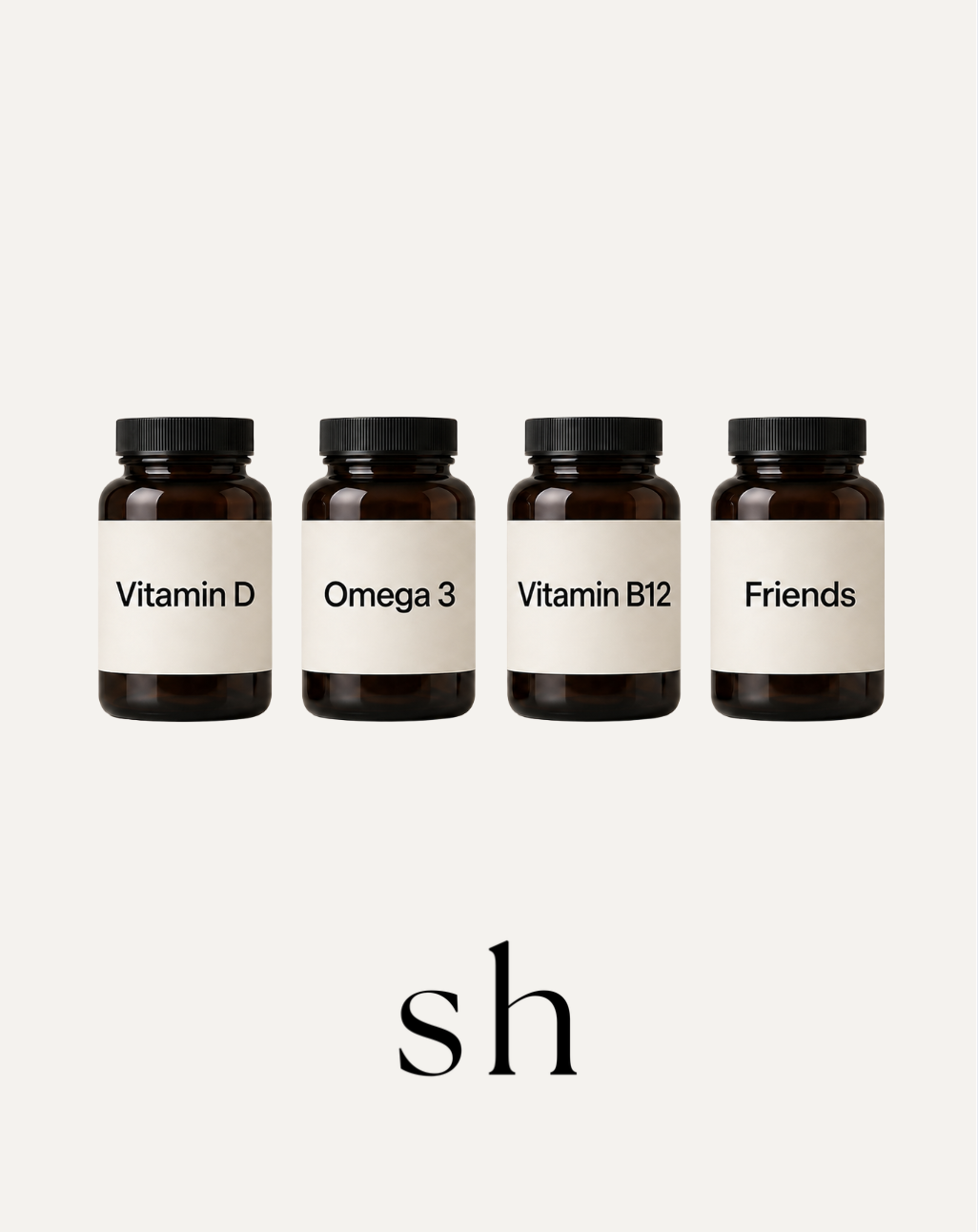
We’re living in the age of optimisation – early alarms set for 6am spin classes, supplements lined up like a science experiment on the bedside table and late nights ending with one final look at a never-ending inbox.
Most of us still file time with friends under indulgence – somewhere below the gym and slightly above financial planning on the list of things we’re supposed to be doing when life gets busy.
Our biology begs to differ.
Strong relationships predict healthier bodies, sharper minds, longer lives, and bigger pay cheques. In other words, pretty much exactly what the early alarms and late nights were supposed to be for anyway.
-
What’s love got to do with it? Social functioning, perceived health, and daily happiness in married octogenarians. Waldinger, R. J., & Schulz, M. S. (2010). Psychology and Aging, 25(2), 422–431.
Lending a hand: social regulation of the neural response to threat. Coan, J. A., Schaefer, H. S., & Davidson, R. J. (2006). Psychological Science, 17(12), 1032–1039.
Loneliness matters: a theoretical and empirical review of consequences and mechanisms. Hawkley, L. C., & Cacioppo, J. T. (2010). Annals of Behavioral Medicine, 40(2), 218–227.
Enjoy this article?
Absolutely no spam. Ever.
About The Author
Shaady Harrison is a British medical doctor, writer and executive advisor specialising in neuroscience, leadership and high performance.