
The Secret Life of Your Gut Microbiome
DR SHAADY HARRISON | 4 minutes
It’s 2015.
A sweet nineteen-year-old with a chronic inflammatory disease called ulcerative colitis has been admitted to hospital. A stubborn and recurrent infection called Clostridium difficile has proved impossible to clear. Our morning ward round finds him lying in bed curled up in a ball. His parents are distraught – he’s lost so much weight that he’s wasting away.
A powerful cocktail of the most expensive drugs in the country has failed to make him better.
Desperate times call for desperate measures.
Today’s course of action is a faecal transplant – a procedure where a tiny sample of stool from a healthy person is transplanted into his colon. Brimming with living bacteria, it’s the ultimate probiotic. It’s just a shame about the packaging.
It’s a week before I see him next.
He’s sitting up, talking, and smiling again – the transformation is remarkable. Billions of microscopic bacteria have made their way into his gut and performed a small miracle – clearing an infection that nothing else had touched.
As we walk out of his room, my gastroenterology professor is buzzing with excitement. He’s reeling off study after study describing the power of the gut microbiome – each sounding more ridiculous than the last. How could the bacteria in our guts influence our immunity, sleep, mood – even stress?
And so began my interest in the gut microbiome.
What Is Your Gut Microbiome?
For most of medical history, your gut was treated as plumbing – a long, muscular tube that digested food, absorbed nutrients and occasionally caused trouble. Everything changed with a single discovery.
There are trillions of microscopic organisms living inside your intestines.
An entire ecosystem teeming with life, your gut is home to a vast, coordinated microbial community that behaves almost like an extra organ.
When this ecosystem is thriving, we feel it.
And when it’s not, we feel that too.
Your Gut Influences Your Brain
Deep in the folds of your intestines, this microscopic community is influencing more of your biology than we once realised.
The bacteria in your gut are in constant conversation with your nervous system.
We used to believe that the brain was the control centre issuing instructions to the rest of the body. But it turns out your gut isn’t just receiving instructions from the brain.
It’s sending them too.
The foods we eat change our gut bacteria, which in turn shape signalling pathways linked to mood and behaviour. In other words, the gut isn’t simply responding to the brain, it’s influencing it too.
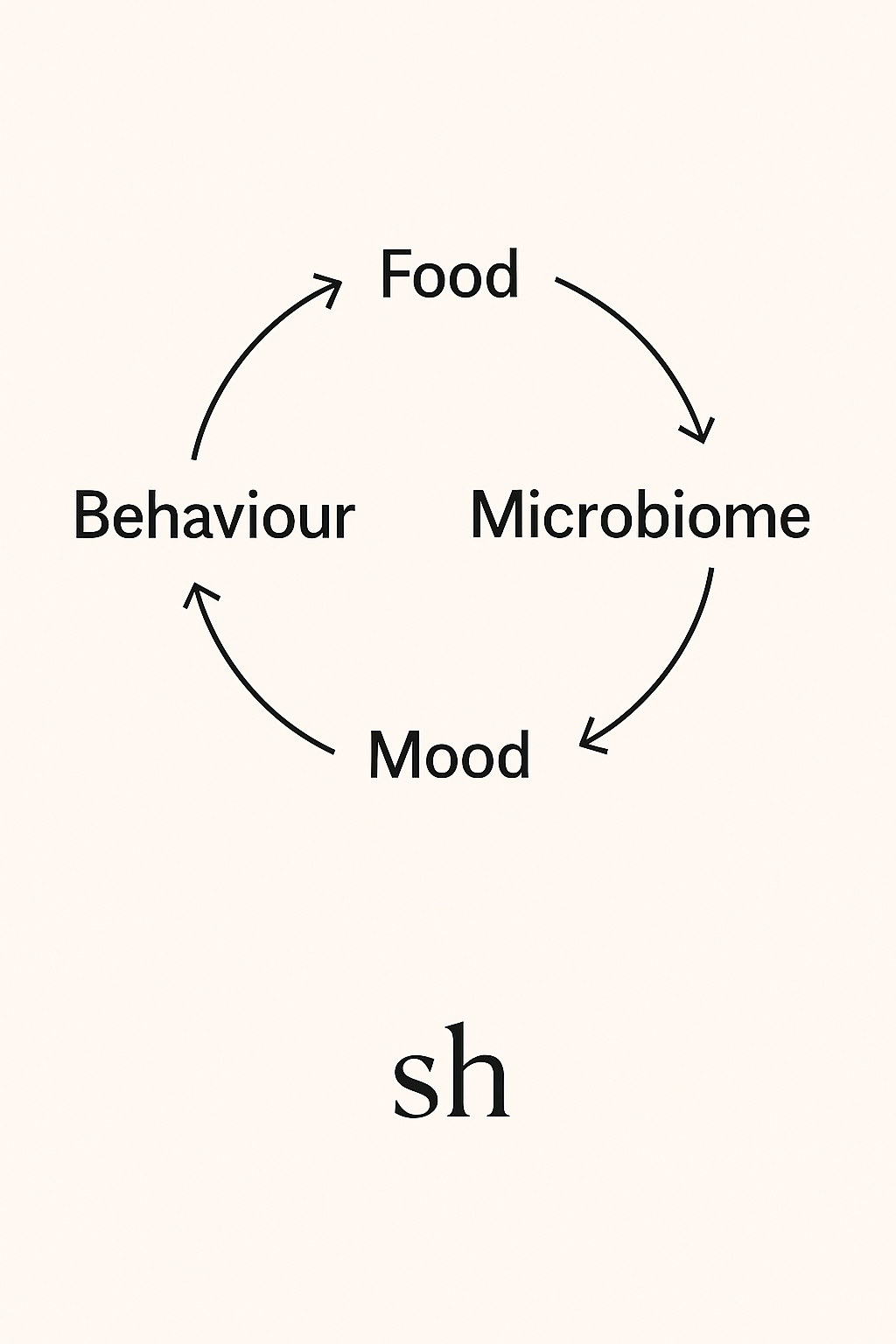
And this is where our messy modern lives start to interfere.
The Lifestyle Problem
Our modern lifestyle has profoundly changed our gut microbiome. Over the last fifty years, the Western microbiome has lost a meaningful proportion of its diversity.
Our gut microbiome evolved for millions of years, and then changed in a single generation.
Ultra-processed food, erratic sleep, chronic stress, antibiotics, sedentary habits – each one has subtly nudged our collective microbiome in completely the wrong direction.
But while your microbiome is as unique as a fingerprint, it’s not fixed like one. This is good news.
The bacteria in your gut constantly shift in response to what you eat, how you sleep, how stressed you are, how often you exercise, and even who you live with.
Small consistent changes can create surprisingly profound effects.
How to Improve Gut Health
A healthy gut doesn’t require extreme diets, complicated protocols or expensive probiotics. The highest yield changes are beautifully simple.
Eat Real Food
Ultra-processed foods feed the wrong microbes. Human biology evolved on nutrition that was varied, seasonal and recognisably whole. We now eat foods with ingredient lists that read like chemistry textbooks. If you wouldn’t find half the items in your kitchen, they probably don’t belong in your body either.
Protect Your Sleep & Stress Levels
Your gut and brain are in constant conversation – microbes respond quickly to shifts in your nervous system. Poor sleep and high cortisol are associated with reduced microbial diversity. Protecting deep sleep and reducing background stress support both systems at once.
Eat the Rainbow
The foods you eat are the most powerful influence on your gut microbiome. A healthy gut isn’t unlocked with supplements – it’s decided by the food you eat. Eat more colourful fruits, vegetables, herbs, whole grains and legumes.
Diversity in your meals creates diversity in your microbiome – one of the clearest markers of gut health.
Move More
Your gut thrives when you do. You don’t need intense workouts – walking, strength training, Pilates, cycling, even stretching – each one improves gut motility, reduces inflammation and supports microbial balance.
Eat Fermented Foods
Yoghurt, kefir, kimchi, sauerkraut and tempeh offer live bacteria in their most natural form. A few servings a week can measurably shift the ecosystem living inside you.
The Missing Piece of the Puzzle
Our understanding of gut health is still evolving. The science is young, complicated and far from complete.
But the writing’s on the wall.
Your gut is one of the most influential – and overlooked – systems in the body.
Look after it.
It’s busy looking after you, too.
-
Diet and the Microbiota–Gut–Brain Axis: Sowing the Seeds of Good Mental Health. Berding K, Zhang D. Nutrients. 2021;13(3):818.
The Detrimental Impact of Ultra-Processed Foods on the Human Gut Microbiome and Gut Barrier. Rondinella D. Nutrients. 2025;17(5):859.
The Role of the Gut Microbiota in Nutrition and Health. Valdés AM, Walter J, Segal E, Spector TD. BMJ. 2018;361:k2179.
Enjoy this article?
Absolutely no spam. Ever.

About The Author
Shaady Harrison is a British medical doctor, writer and private advisor specialising in the intersection of psychology, calm and performance.