
Much Ado About Digestion
DR SHAADY HARRISON | 3 minutes
It takes roughly 24–72 hours to digest your breakfast.
The process is long and laborious – an entire network of organs gets to work as the meal gradually makes its way through a digestive tract almost as long as a London bus.
Hour after hour, dozens of enzymes break down each mouthful while waves of muscle work together to push it inch by inch through the body.
All that fuss for a meal that disappeared from our plates in about six minutes.
Consuming food is quick and easy: processing it takes time, energy and work.
Which brings us to information.
All You Can Eat
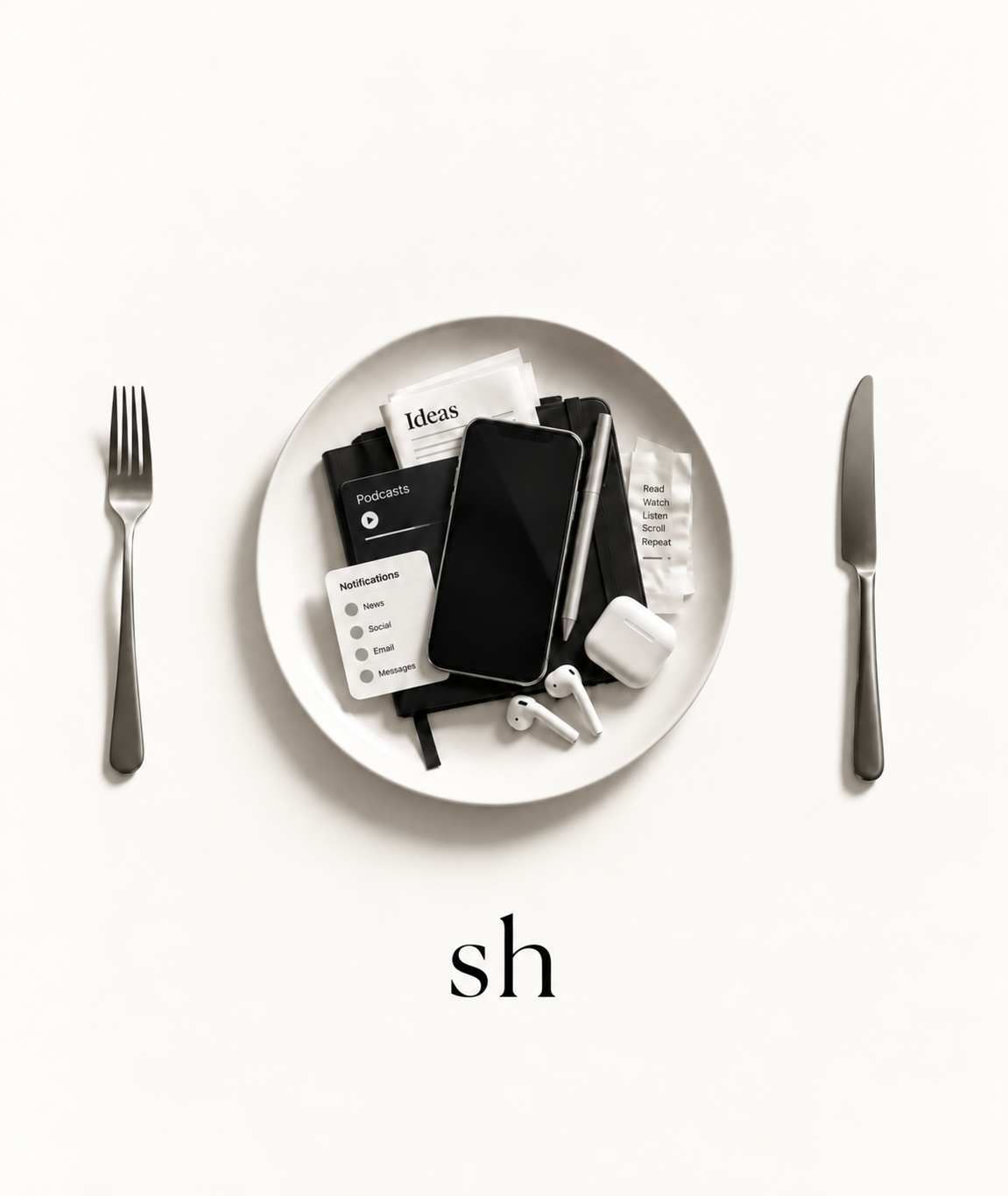
In the history of our planet, humans have never consumed more information.
The digital economy effectively removed the cost of publishing, flooded the world with an infinite supply of news, commentary and noise, then built an entire industry around keeping our eyes fixed on it.
By breakfast time, the average human being’s been exposed to more information than our ancestors would have encountered in a week.
But consuming something isn’t the same as digesting it. Modern media’s become incredibly good at getting information into the human brain – whether any of it actually sticks is apparently beside the point.
Food For Thought
The body doesn’t swallow a cheese sandwich and keep it intact for future reference.
It tears the whole thing apart.
Proteins are dismantled into amino acids, carbohydrates are stripped down into simpler molecules, and the useful bits are absorbed and put to better use. Food doesn’t become nourishment just because it happens to pass through.
Information doesn’t become wisdom just because it happens to pass through either.
Every idea we properly understand has been through a small act of demolition: it’s been pulled apart, tested, hooked onto something we already knew and rebuilt in our own words so it actually makes sense to us.
Real learning involves cognitive effort and friction.
So why does consuming content feel so easy?
The modern world has got information delivery down to a tee, but the parts of learning that actually change our thinking feel messy – they involve mulling things over, struggling to remember details, explaining ideas badly and every so often getting things completely wrong.
In other words, not exactly an easy sell when there’s another dopamine hit landing on our plates in a few seconds.
Rest & Digest
Every streaming app keeps a meticulous count of what we've listened to, watched and read.
Not one of them has ever bothered to ask what we did with it all afterwards.
The human nervous system isn’t wired for a constant stream of stimulation; it works best in cycles – periods of input followed by periods of absolutely nothing at all.
Some of the brain's most important work happens in the moments that look remarkably close to a waste of time.
Standing in a queue with nothing to look at, taking the long way home without a podcast on, trying to remember something from earlier while staring out of a train window.
We need blank space in our heads for the magic to happen.
The world may have crowded out the quiet, but it’s no coincidence that some of our best insights still show up when we’re zoning out in the shower.
-
Bohn, R. & Short, J. (2009). How Much Information? 2009 Report on American Consumers. UC San Diego.
Bjork, R. A. (1994). Memory and metamemory considerations in the training of human beings. In Metacognition: Knowing about Knowing. MIT Press.
Roediger, H. L. & Karpicke, J. D. (2006). Test-enhanced learning. Psychological Science, 17(3), 249–255.
Enjoy this article?
Absolutely no spam. Ever.

About The Author
Shaady Harrison is a British medical doctor, writer and executive advisor specialising in the intersection of psychology, calm and performance.