
How To Stop Waiting
DR SHAADY HARRISON | 3 minutes
He’s about to accidentally destroy a billion-dollar industry.
The year’s 1975.
A young engineer at Kodak walks into a meeting carrying something new. He lifts it up, points it at a colleague and presses a button.
Steven Sasson has just taken the first digital photograph in history.
“That’s cute – but don’t tell anyone about it.”
The reaction isn’t quite what he’s expecting. Polite but dismissive, they bury it – digital photos just don’t make sense in Kodak’s business model. Why build something that completely replaces what you sell?
So they wait.
Over the next few years, profits hold and film continues to dominate.
But in the background, the tide is turning.
Digital just keeps getting better, and other companies start to act. Kodak, who had seen the future first, end up moving last.
And by the time they try and catch up, the ship’s already sailed.
Why We Wait
When it comes to making big changes, we like to think waiting is a logistical issue – if we had more time, energy or information, we’d act.
In reality, things are rarely that simple.
Our nervous system really doesn’t like uncertainty.
Ambiguity is stressful – it activates similar pathways in our brains to physical pain. So instead of committing to change, we wait.
Our brains overestimate the cost of action and underestimate the cost of staying still.
This is partly because one feels like a decision, while the other doesn’t. Action triggers a full and comprehensive risk assessment, getting dragged into the spotlight and examined from every angle. Inaction on the other hand, slips by almost unnoticed.
Familiar problems feel safer than unfamiliar improvements.
So we wait for better timing.
Which as it turns out, rarely shows up anyway.

The Cost of Waiting
There’s almost always a genuinely good reason for waiting. So we patiently hold out – assuming time will make things clearer.
But waiting’s more expensive than it looks.
Unresolved decisions don't sit quietly in the background like unused files in a drawer somewhere. They take up space, burning through cognitive resources without resolution. The longer they stay open, the more headspace they consume.
These open loops sit in working memory and resurface unpredictably, draining mental bandwidth in the process.
Waiting doesn’t feel like a gamble – it feels like being sensible. This creates a predictable pattern – we wait until the current situation becomes intolerable before we finally move to fix it.
Do The Thing
Fear grows when a decision feels binary: stay or go, start or don’t, now or never.
But there’s no need for us to be so dramatic.
Our nervous system handles gradients better than gateways. Most of the big changes we torture ourselves over start with small steps – an email, a message, a deposit, a conversation.
Small actions reduce ambiguity, which in turn calms the nervous system.
The most successful people move faster, instead of holding out for the ideal conditions to materialise. They act before things feel certain, and spend a little less time hanging around in the waiting room.
Humans regret inaction more than wrong actions.
We adapt surprisingly well when things go badly.
We adapt even faster once things have begun.
-
Saving for the future self: Neural measures of future self-continuity predict temporal discounting.
Ersner-Hershfield, H., Wimmer, G. E., & Knutson, B. (2009). Social Cognitive and Affective Neuroscience, 4(1), 85–92.Your Future Self: How to Make Tomorrow Better Today.
Hershfield, H. (2023). Little, Brown Spark.Temporal differences in trait self-ascription: When the self is seen as an other.
Pronin, E., & Ross, L. (2006). Journal of Personality and Social Psychology, 90(2), 197–209.Future self-continuity is associated with improved health and increased exercise behavior.
Rutchick, A. M., Slepian, M. L., Reyes, M. O., Pleskus, L. N., & Hershfield, H. E. (2018). Journal of Experimental Psychology: Applied, 24(1), 72–85.
Enjoy this article?
Absolutely no spam. Ever.
About The Author
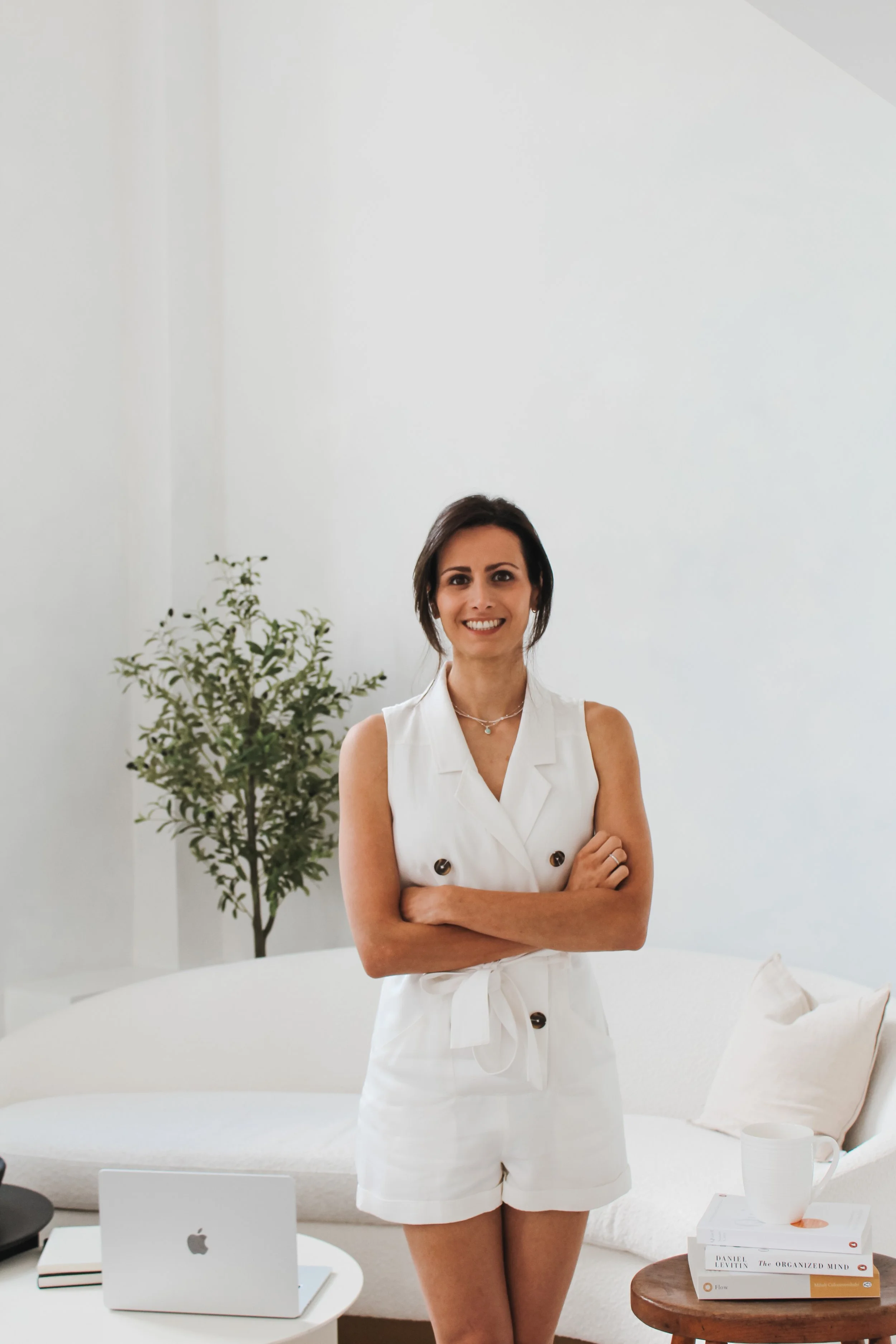
Shaady Harrison is a British medical doctor, writer and private advisor specialising in the intersection of psychology, calm and performance.