
The Art of Self-Loathing
DR SHAADY HARRISON | 4 minutes
It’s 1908 and a fancy art gallery in Paris is busy getting ready for a major exhibition. The new collection’s been a long time coming – early previews have gone down a storm and the gallery’s counting down the days to the grand unveiling.
All that’s left is the artwork’s journey from the studio to the exhibition walls.
But the paintings don’t make it.
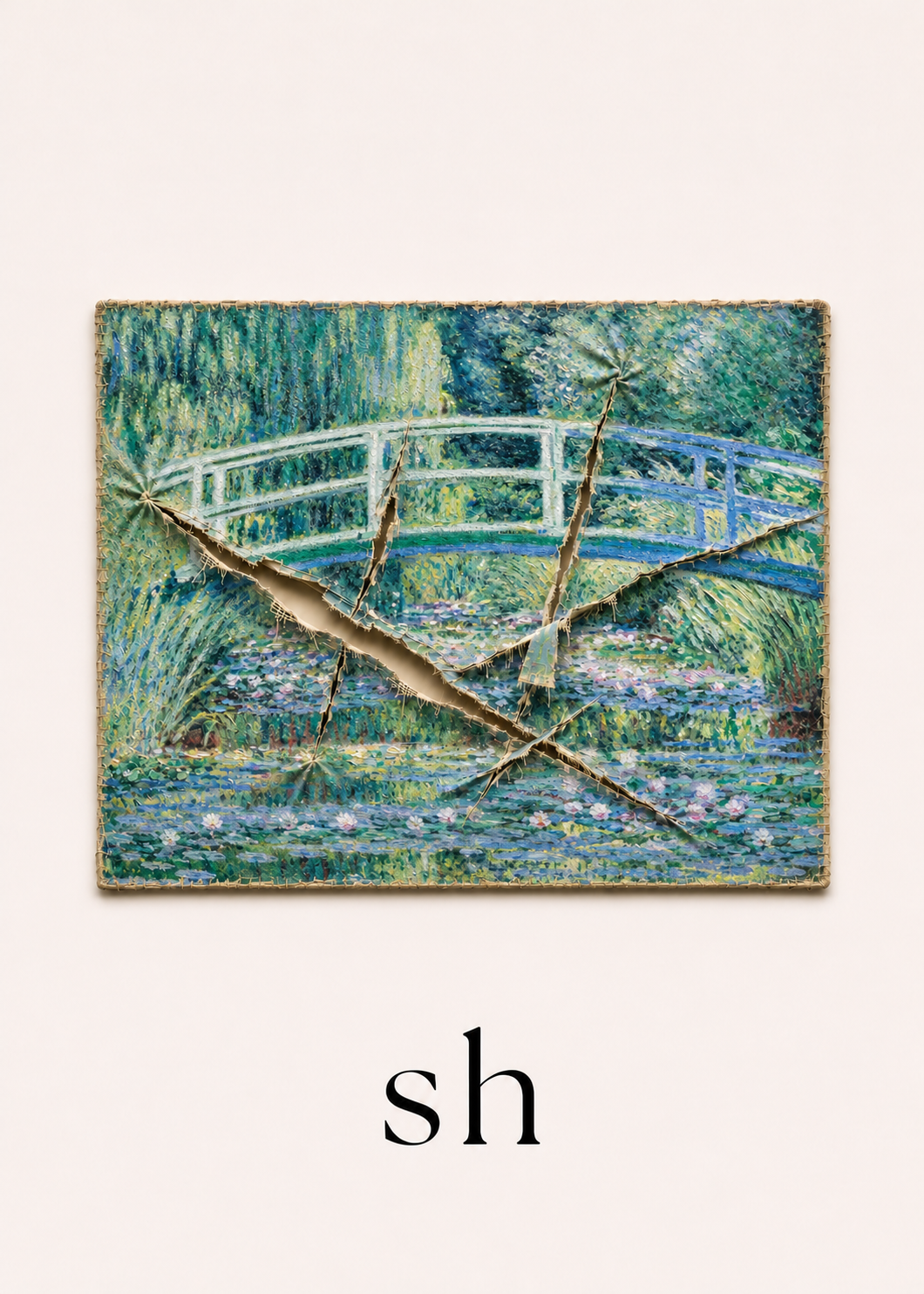
Shortly before they’re due to leave, a man takes a knife and destroys fifteen of them, slashing through three years of painstaking work worth millions in modern money.
The knife belongs to a 67-year-old artist called Claude Monet, and unfortunately, so do the paintings.
Tough Crowd
Self-criticism didn’t arrive by accident – our ancestors lived in a brutal world where one wrong move could be fatal, so catching mistakes early became permanently embedded in human nature. Being our own toughest critic meant problems could be corrected in private, which was far safer than having them picked apart in public.
Thousands of years later, the danger’s passed but the brain hasn’t quite got the memo.
A good kicking from an inner critic doesn’t always look like a vicious attack; some of its best work happens in the background with a steady drip of regrets, comparisons or unsolicited feedback, delivered daily.
Self-loathing sticks around for the same reason most bad habits do: the brain thinks it's doing us a favour.
From the inside, a harsh word here and there feels like a small price to pay for avoiding a bigger problem later – repeated often enough, the brain learns to treat hostility towards the self as useful and protective.
It's also deeply familiar, and like most toxic relationships, therefore a lot harder to leave than meets the eye.
Inside Job
The threat system in our bodies doesn't bother asking questions when it comes to potential danger. As soon as something feels hostile it reacts first and thinks later – cortisol rises, attention narrows and the nervous system gets ready to brace for impact.
It doesn’t stop to check who the attacker is.
Self-criticism and outside criticism activate much of the same threat circuitry – the body has no separate category for nastiness that starts from within. An unreasonable inner critic rarely wears us down with a single big hit, instead it steadily chips away with a constant supply of smaller ones that never stop coming. Our nervous system’s designed for short bursts of danger, followed by genuine stretches of safety and quiet.
The voice in our heads doesn’t just follow us home, it sits down for dinner and joins us on the sofa.
A threat from outside eventually passes – one that comes from the inside has nowhere to go, so the body stays braced without ever registering that we’re the ones throwing the punches.
Have a Word
Many inner critics started life as somebody else's voice, picked up early from a parent or teacher, and have been happily running on repeat ever since.
That voice in the background may sound like white noise, but the body keeps on listening.
There’s a fine line between self-development and self-sabotage; under constant review the brain shifts into defence mode, making our confidence and best thinking go quiet. The critic turns into the boss who motivates exclusively through humiliation, then can't for the life of them work out why nobody's putting their hand up.
But like any cognitive pattern, self-criticism can be unlearned.
The pathways that carry the old voice were built through repetition and fade the same way. Small changes in how we frame things seem to matter – ‘I lost my temper and screamed at the kids’ describes an event that can be fixed, ‘I’m a terrible parent’ describes an identity, and identities have an unfortunate habit of sticking around.
Self-criticism fuels stress, rumination, anxiety, burnout and depression – a questionable list of credentials for getting the best from anyone in the long haul.
In other words, for a voice so convinced it's keeping us sharp, it’s mostly just been taking the credit.
-
Bad is stronger than good. Baumeister, R. F., Bratslavsky, E., Finkenauer, C., et al. (2001). Review of General Psychology, 5(4), 323–370.
When the social self is threatened: Shame, physiology, and health. Dickerson, S. S., Gruenewald, T. L., & Kemeny, M. E. (2004). Journal of Personality, 72(6), 1191–1216.
Self-talk as a regulatory mechanism: How you do it matters. Kross, E., Bruehlman-Senecal, E., Park, J., et al. (2014). Journal of Personality and Social Psychology, 106(2), 304–324.
Enjoy this article?
Absolutely no spam. Ever.

About The Author
Shaady Harrison is a British medical doctor, writer and executive advisor specialising in neuroscience, leadership and high performance.